TL;DR:
- Effective wedding lighting profoundly shapes the ambiance, guest experience, and emotional tone throughout the event.
- Layering five distinct lighting types—ambient, task, accent, decorative, and dynamic—creates depth and seamless scene transitions.
Few elements shape a wedding atmosphere as profoundly as light. It sculpts the room, flatters your guests, and gives each moment its own emotional weight. Yet for most couples, this guide to luxury wedding lighting remains unexplored territory until far too late in the planning process. The result is beautifully dressed venues that feel flat in photographs and underwhelming in person. Lighting professionals refer to this discipline as architectural and event illumination design, and when it is done well, lighting shapes the guest experience from the entrance right through to the final dance.
Table of Contents
- Key takeaways
- Understanding types of luxury wedding lighting
- Creative wedding lighting ideas and effects
- Planning and budgeting for wedding lighting
- The lighting timeline: from concept to wedding day
- Troubleshooting and safety considerations
- My honest take on wedding lighting
- How professional photography captures your lighting design
- FAQ
Key takeaways
| Point | Details |
|---|---|
| Layer your lighting types | Combine ambient, accent, and decorative sources to create depth and emotional shifts across the event. |
| Prioritise the most photographed spots | Concentrate investment on the entrance, head table, dance floor, and cake display for the greatest visual return. |
| Start planning early | Begin venue power checks and designer conversations 12 to 18 months before the wedding. |
| Treat lighting as a cue stack | Programme scene transitions to mirror the event timeline, from intimate ceremony to energetic reception. |
| Coordinate across all suppliers | Align your lighting designer with florists, planners, and photographers to avoid costly design drift. |
Understanding types of luxury wedding lighting
Luxury wedding lighting is not a single fixture or one dramatic effect. It is a composed vocabulary of five distinct layers, each playing a specific role in the story of your day.
- Ambient lighting forms the overall wash of light in a space. Think soft, diffused sources such as chandeliers for weddings, ceiling wash fixtures, or warm LED panels that replace harsh venue house lights.
- Task lighting serves practical purposes: reading menus, signing the register, navigating between tables. It is subtle but necessary.
- Accent lighting draws the eye to specific architectural features, such as draped fabric, floral columns, or stone archways, using tightly focused beams.
- Decorative lighting is the jewellery of the room. Fairy lights, Edison bulbs, geometric lanterns, and ornate candelabras fall into this category. They contribute to the mood as much as they illuminate.
- Dynamic or entertainment lighting includes moving heads, colour-changing LEDs, laser projectors, and strobe effects deployed during the reception's most energetic moments.
The genius of layered lighting is that these five types work in concert. Layering these functions creates depth and allows the atmosphere to shift from the hushed reverence of a ceremony to the warmth of a candlelit dinner and finally to the electric energy of the dance floor.
Design your lighting in phases: ceremony, cocktail hour, dinner, and dancing. Each phase deserves its own lighting cue. During the ceremony, soft amber washes and directed spotlights on the couple communicate intimacy. At cocktail hour, raise the ambient slightly and introduce uplighting to encourage movement and conversation. Dinner calls for warm, low-level accents with pin-spotting on centrepieces. Dancing is where dynamic colour and motion come into their own.
Pro Tip: Ask your lighting designer to create a printed cue list that mirrors your event timeline. Every lighting change should have a named trigger, whether that is the couple's entrance, the first speech, or the first dance.
Creative wedding lighting ideas and effects
With the foundational framework established, the creative possibilities become genuinely exciting. The following effects are among the most popular in luxury wedding decor, each with distinct characteristics suited to different venue styles.
Uplighting and architectural accents
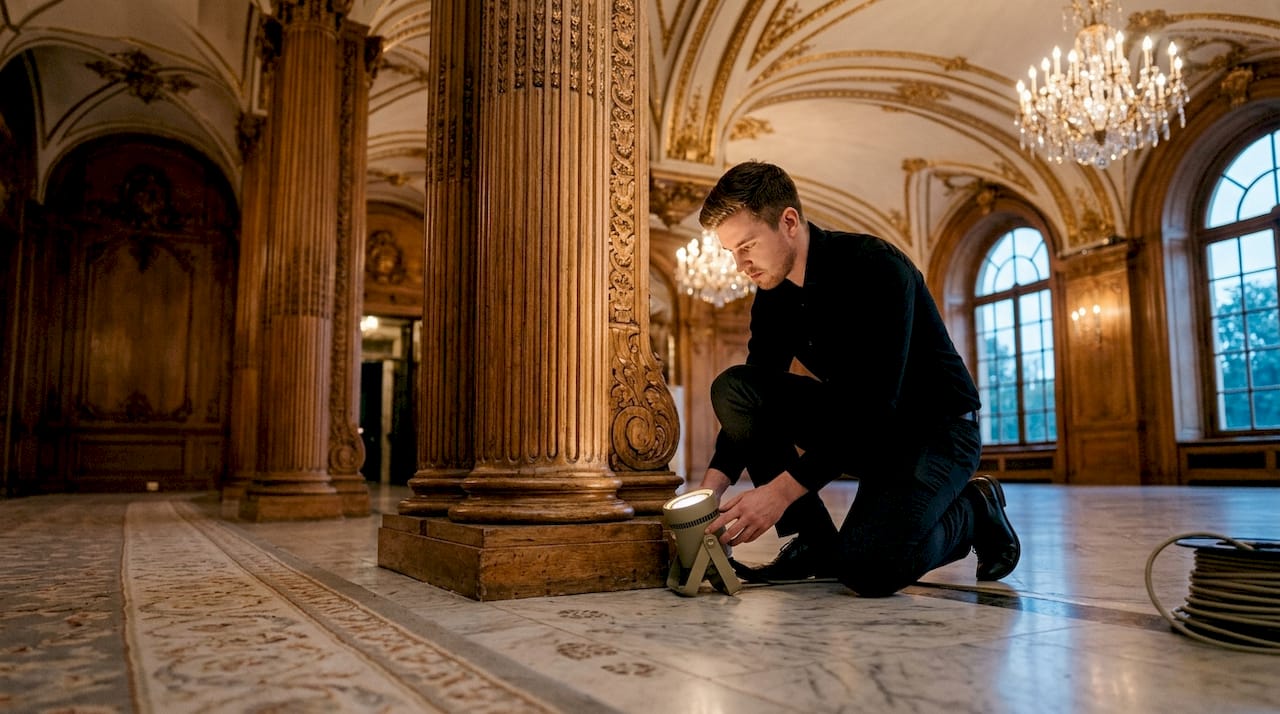
Uplighting places fixtures at floor level, casting light upward along walls, columns, and drapes. The effect is transformative, turning a plain function room into something that feels cinematic and regal. Colour choice matters enormously here. Warm champagne and rose gold tones suit traditional venues, while deep sapphire or forest green can create a moody, contemporary drama in modern spaces. Complete uplighting packages typically range from £400 to £2,000 depending on venue size and fixture count.
String lights, fairy lights, and Edison bulbs
Few romantic lighting suggestions compete with the warmth of a string-light canopy suspended above a dining space. When draped in loose, undulating swags across a barn ceiling or terrace, Edison bulbs create an intimate quality that no single spotlight can replicate. The warm, slightly amber glow photographs beautifully and flatters every skin tone in the room.
Pin-spotting focal points
Pin-spotting is one of the most underused elegant lighting ideas available to couples. A single, precisely aimed beam falling on a centrepiece arrangement turns flowers into sculpture. The same technique applied to the wedding cake, the head table, or a bespoke installation creates focal points that guide the guest's eye intentionally across the room.
Gobos and custom monograms
A gobo is a metal or glass stencil fitted into a spotlight that projects a pattern or image. Custom monograms, floral motifs, or geometric designs projected onto a dance floor, wall, or ceiling are among the most personalised touches in wedding lighting options available today.
| Effect | Best setting | Approximate cost range |
|---|---|---|
| Uplighting (20 fixtures) | Large ballroom or marquee | £600 to £1,200 |
| String light canopy | Barn, courtyard, or terrace | £400 to £900 |
| Pin-spotting (10 points) | Tables, cake, and head table | £200 to £500 |
| Custom gobo monogram | Dance floor or feature wall | £150 to £350 |
| Moving head effects | Dance floor and reception | £500 to £1,500 |
Pro Tip: For outdoor or heritage venues with limited power access, battery-operated LED fixtures reduce cable clutter significantly and protect original flooring and wall finishes.
Planning and budgeting for wedding lighting
A creative lighting scheme means very little without sound logistical planning behind it. The most common mistake couples make is treating lighting as a last-minute add-on rather than a structural part of the design process.
Begin with your venue's power infrastructure. Identify available socket types, circuit capacities, and any rigging restrictions on ceilings and walls. Early power mapping is the single most important step in avoiding last-minute failures on the day. Always plan for a 20 per cent load headroom above your estimated draw to accommodate unexpected additions or vendor equipment.
Here is a practical sequence for budgeting and procurement:
- Allocate your lighting budget as a percentage of total decor spend. Industry planning guides suggest 15 to 25 per cent of the overall decor budget for lighting at a luxury wedding.
- Identify your highest-impact zones first. Prioritising photographed spots such as the entrance, sweetheart table, dance floor, and cake display yields the strongest visual return per pound spent.
- Obtain itemised quotes from at least two professional lighting designers. Request a full breakdown covering equipment hire, rigging, programming, setup, operation, and de-rig.
- Ask specifically about generator hire and permits for outdoor events. These costs are frequently omitted from headline quotes.
- Clarify overtime fees. If your event runs beyond the agreed time, what is the additional hourly rate for the lighting technician on site?
| Budget tier | Typical scope | Approximate range |
|---|---|---|
| Entry luxury | Uplighting plus fairy light canopy | £1,500 to £3,000 |
| Mid luxury | Above plus pin-spotting and gobo | £3,000 to £6,000 |
| Full production | Full rig with moving heads, cue programming, and technician | £6,000 to £15,000+ |
Pro Tip: Hiring a dedicated lighting designer rather than bundling lighting with your DJ or AV company almost always produces a more refined result. A specialist will programme deliberate scene transitions rather than defaulting to a single setting for the entire evening.
The lighting timeline: from concept to wedding day
Successful execution of a luxury lighting scheme requires decisions made at the right moments over an extended period.
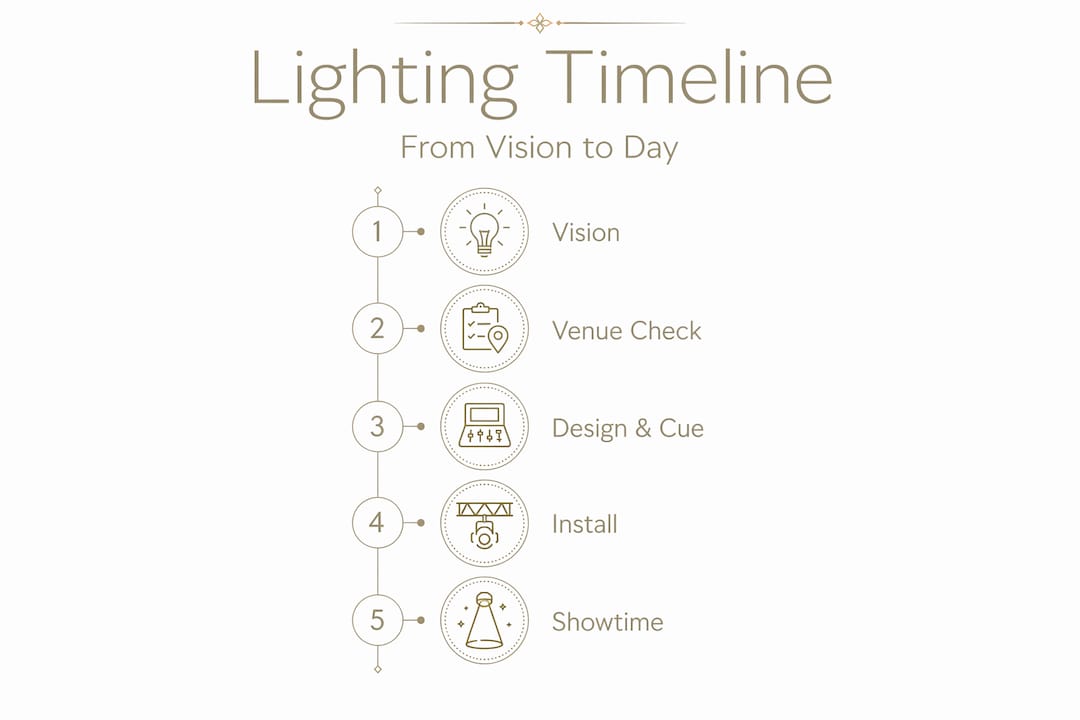
- 12 to 18 months before: Define your aesthetic vision and assess whether your chosen venue can physically support it. Confirm rigging points, power capacity, and any listed building restrictions that could affect your plans.
- 9 to 12 months before: Begin conversations with lighting designers. Share mood boards, your venue floor plan, and your provisional event timeline. Lighting should be integrated from the earliest planning stages to preserve design consistency across all suppliers.
- 6 to 9 months before: Secure all safety documentation, power approvals, and permits. Lock in your final lighting looks for each phase of the day, from ceremony through to reception.
- 2 months before: Finalise the cue list and align it with your full event timeline. Programmed scene transitions should correspond to specific moments: the couple's entrance, speeches, the first dance, and the cake cut.
- 1 to 2 weeks before: Conduct a full technical rehearsal at the venue if possible. Verify all fixtures are operational, all gobos are correctly aligned, and backup equipment is on site.
Key checks for your rehearsal session:
- Confirm every cue trigger with your lighting technician and event coordinator
- Test battery-powered and wireless fixtures for charge duration across the full event length
- Check that dynamic effects such as moving heads and lasers clear all seating areas safely
Pro Tip: Build a simple one-page brief that lists each lighting cue alongside its event trigger and the name of the person responsible for calling it. Share this with your coordinator, DJ, and photographer so everyone transitions at precisely the right moment.
| Timeline stage | Primary task |
|---|---|
| 12 to 18 months | Vision definition and venue suitability assessment |
| 9 to 12 months | Designer consultations and concept development |
| 6 to 9 months | Permits, safety approvals, and final design lock |
| 2 months | Cue list finalisation and timeline alignment |
| 1 to 2 weeks | Technical rehearsal and equipment checks |
Troubleshooting and safety considerations
Even the most carefully designed scheme can encounter obstacles. Knowing the common failure points allows you to plan around them with confidence.
Power supply issues are by far the most frequent cause of lighting failures at weddings. Underestimating the combined draw of lighting, DJ equipment, catering appliances, and ambient heating is an extremely common error. Integrate your lighting loads with all other vendors' power requirements well in advance, and always include that 20 per cent headroom mentioned earlier.
Dynamic effects require particular care. Laser safety parameters must be validated against beam power, angles, and guest proximity before the event. Never place laser projectors without vendor-supplied mounting instructions and a safe-distance assessment. For modest indoor receptions, one or two RGB laser projectors are typically sufficient. Larger spaces may require three or four stage-grade moving head units.
Lighting should never be designed in isolation. A breathtaking scheme that clashes with the florist's colour palette or overwhelms the DJ's visual setup will feel disjointed rather than luxurious.
Additional pitfalls to avoid:
- Over-lighting: More fixtures do not automatically mean more impact. Discipline in placement is what separates elegant from excessive.
- Ignoring transition cues: A room that shifts from ceremony to dinner without any lighting change feels static and misses an opportunity to create emotional punctuation.
- Design drift: When lighting decisions are made piecemeal rather than as part of a unified vision, the final result often lacks cohesion. Appoint one person, ideally your lighting designer, as the guardian of the overall lighting aesthetic.
Pro Tip: For venues with historic floors or strict rigging restrictions, wireless LED fixtures are not merely a workaround. They are often the superior solution, offering positioning flexibility that cabled rigs simply cannot match.
My honest take on wedding lighting
I have been photographing luxury weddings for many years, and the consistent pattern I see is this: the couples who invest in professional lighting design receive photographs that feel like they belong in an editorial spread, while those who leave lighting as an afterthought receive images that require heavy post-processing to feel warm and considered.
What I have learned is that lighting is not static decor. It is a time-based cue stack with a precise emotional function at every stage of the day. The shift from the gentle, intimate glow of the ceremony to the charged, colour-rich energy of the dance floor is not an accident. It is a choreographed sequence, and when it lands correctly, guests feel it without knowing why.
The teams that consistently produce the most breathtaking results are those where the lighting designer, photographer, florist, and planner have spoken before anyone has lifted a fixture. Integrated teams eliminate the guesswork and protect the vision. Fragmented suppliers, each working from their own brief, almost always produce design drift.
My strongest advice to you: do your power mapping before you do your mood board. A glorious lighting concept built on an inadequate power infrastructure will cost you more to fix on-site than it would have done to address it twelve months earlier. Start with the engineering, then let the artistry follow.
— Rashpal
How professional photography captures your lighting design
All of that careful, considered work deserves to be preserved in images that do justice to every detail.
At Rashpal-photography, we specialise in capturing the full visual richness of luxury weddings, including the atmospheric shifts, the candlelit intimacy, and the electric brilliance of a perfectly lit reception. Our Classic Investment package provides 14 hours of coverage across your wedding day, giving us the time to document every lighting transition and every beautifully lit moment as it unfolds. We work closely with your lighting designer and venue team so that our camera positions always take full advantage of the light you have so carefully designed. To explore our full range of wedding photography services, or to discuss how we can align our approach with your lighting vision, we would love to hear from you.
FAQ
What is the most important type of wedding lighting?
Ambient lighting forms the foundation of any lighting design, setting the overall mood and tone. Without a considered ambient layer, accent and decorative effects lose their impact and the space can feel unbalanced.
How much should I budget for luxury wedding lighting?
A luxury entry-level lighting scheme typically costs between £1,500 and £3,000, covering uplighting and a fairy light canopy. Full production rigs with moving heads, programmed cues, and a dedicated technician can reach £15,000 or more for large venues.
When should I book a wedding lighting designer?
Book your lighting designer nine to twelve months before the wedding, and begin venue power checks at least twelve to eighteen months in advance. Early planning prevents costly last-minute compromises and protects your design vision.
Are chandeliers always the best choice for luxury weddings?
Chandeliers are a stunning focal point but work best as a decorative centrepiece rather than a primary light source. They are most effective when layered with uplighting, pin-spotting, and ambient wash to create true depth rather than a single dramatic effect.
Can I use battery-powered fixtures at heritage or outdoor venues?
Yes, and in many cases they are the preferred solution. Battery and wireless LED fixtures protect original flooring, eliminate trailing cables, and offer repositioning flexibility that hard-wired rigs cannot provide.
Recommended
- How to Select your Wedding Music Rashpal Photography | Wedding Photographer Uxbridge, UK
- Rashpal Photography | Wedding Photographer, Uxbridge, UK
- Gold Engagement Shoot Rashpal Bhachu | Engagement shoots Wedding Photographer, Uxbridge, UK
- Silver Engagement Shoot Rashpal Bhachu | Engagement shoots Wedding Photographer, Uxbridge, UK