TL;DR:
- Many couples overlook black and white wedding photos, assuming they are merely nostalgic or artistic filters. Black and white imagery effectively strips away distractions, emphasizing genuine emotion, facial expressions, and human connections during key moments. Properly used, it deepens storytelling and enhances visual contrast, light, and texture, producing timeless and impactful images.
Many couples assume black and white wedding photos are simply a nostalgic filter, something reserved for ageing albums or a lack of creative options. That assumption deserves a closer look. The truth is that understanding why choose black and white wedding photos comes down to something far more profound: the capacity of monochrome imagery to strip away visual noise and reveal the raw, unguarded emotion of one of the most significant days of your life. This article explores the artistic, emotional, and practical reasons that make black and white photography not an afterthought, but a deliberate and powerful choice.
Table of Contents
- Key takeaways
- Why choose black and white wedding photos for emotional depth
- The artistic power of light, contrast, and composition
- Black and white vs colour: choosing the right moments
- Working with your photographer on monochrome imagery
- My perspective on choosing black and white with intention
- Capture your wedding story with Rashpal Photography
- FAQ
Key takeaways
| Point | Details |
|---|---|
| Emotion takes centre stage | Black and white removes colour distraction, placing full focus on expressions, gestures, and human connection. |
| Artistic depth through light | Monochrome transforms contrast, shadow, and form into cinematic compositions that colour cannot replicate. |
| Not every moment suits it | Colour remains vital when meaning lives in rich hues, such as a vivid sari or floral arrangement. |
| Timeless over trendy | Black and white photographs age gracefully, remaining elegant and relevant decades after the wedding day. |
| Communication is key | Discuss your preference with your photographer before the day so they can plan and shoot with monochrome in mind. |
Why choose black and white wedding photos for emotional depth
Colour is rich, joyful, and often essential. But colour also competes. A vivid red table arrangement, mismatched guest outfits, or a brightly lit reception hall can pull the eye away from the very thing that matters most in a wedding photograph: the people and what they are feeling.
Black and white removes visual distractions, placing every ounce of the viewer's attention on facial expressions, body language, and the quiet interplay between two people. When your father takes your hand just before you walk down the aisle, or your partner's eyes fill with tears during the vows, those moments carry a weight that colour can sometimes dilute. Monochrome does not diminish them. It amplifies them.
The benefits of black and white wedding photos for emotional storytelling are particularly evident in candid, unposed moments:
- The first look. The sharp intake of breath, the trembling hands, the wide eyes. Without colour filling the frame, the viewer is drawn entirely into that exchange.
- The ceremony. Reactions from guests, quiet tears, gentle smiles. These become the story when distracting backgrounds recede into tonal gradients.
- The first dance. The closeness, the movement, the soft blur of a spinning dress. Black and white gives these images a cinematic, almost dreamlike quality.
- Quiet in-between moments. A bride sitting alone, a groom straightening his sherwani. These intimate pauses become portraits of contemplation rather than snapshots.
Black and white increases viewer attention to human interaction by removing the colour dimension entirely. The emotional impact of black and white photos, when applied with intention, is not a stylistic flourish. It is a storytelling decision.
Pro Tip: Ask your photographer to keep both the colour and the black and white version of your most emotionally charged moments. You may find the monochrome version moves you in a way the colour version simply does not.
The artistic power of light, contrast, and composition
Photography, at its most refined, is the art of controlling light. Black and white wedding photography strips every other variable away and places light, shadow, texture, and form at the absolute centre of the image. The result is photographs that feel less like records of an event and more like fine art prints.
Black and white forces photographers to focus on light, contrast, form, and spatial relationships without relying on colour as a compositional crutch. For a couple photographed near a grand arched window, the soft gradients of light falling across a face create a portrait of extraordinary depth. That same image in colour might be distracted by the shade of a wall or the pattern of a curtain. In monochrome, it breathes.
There are specific technical advantages that make black and white wedding photography artistically compelling:
- Difficult lighting becomes an asset. Black and white performs well in high-contrast or harsh lighting conditions, such as midday sun, venues with flash restrictions, or spaces lit by large windows. Conditions that might create awkward colour casts become dramatic tonal contrasts instead.
- Composition becomes clearer. When colour is removed, the structural bones of an image, its lines, shapes, and tonal balance, are immediately visible. Strong compositions become stronger. Weak ones become obvious.
- Texture and fabric gain dimension. Intricate embroidery on a lehenga, the weave of a linen suit, the veil catching the afternoon light. Monochrome renders these textures with a richness that colour occasionally flattens.
Using black and white as a diagnostic tool also reveals composition issues more clearly, which is one reason it sharpens a photographer's eye across all their work. When your photographer has that instinct, every image they create, colour or monochrome, benefits from it.
Pro Tip: When scouting your venue or discussing your photography plan, point out the architectural details and light sources that appeal to you. These are precisely the elements that translate most beautifully into artistic black and white wedding photos.
Black and white vs colour: choosing the right moments
Neither approach is universally superior. The question is always: does the meaning of this image depend on colour? If the answer is yes, colour is non-negotiable. If the answer is no, monochrome will almost certainly strengthen the image.
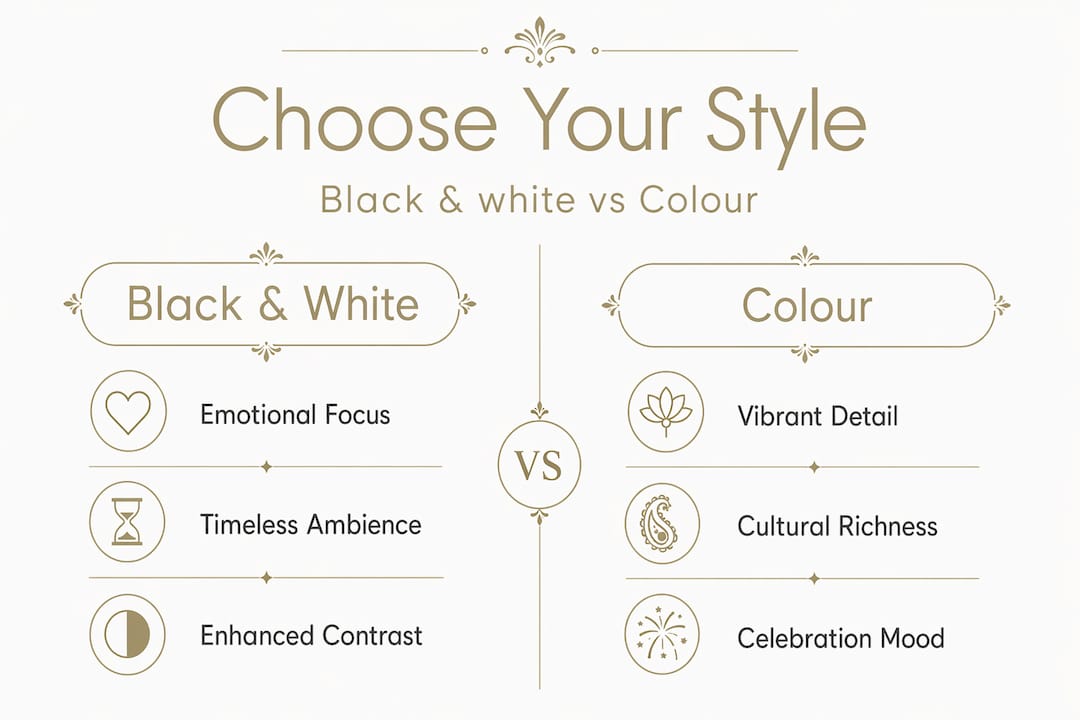
If meaning depends on colour, removing it collapses the image entirely. A breathtaking arrangement of deep orange marigolds at a Hindu ceremony, a bride's crimson dupatta caught in a gust of wind, or a reception lit entirely by jewel-toned lanterns: these moments live in their colour. Converting them to black and white would not create art. It would create loss.
The following table offers a practical guide for deciding which approach serves each type of wedding moment:
| Moment or condition | Best approach | Reason |
|---|---|---|
| Vows and first look | Black and white | Emotion is the entire subject; colour adds nothing |
| Vibrant cultural details (sari, florals, decor) | Colour | Meaning and beauty are inseparable from the hue |
| Candid guest reactions | Black and white | Expressions carry the story without colour interference |
| Dramatic architectural venue | Black and white | Contrast and form create regal, cinematic depth |
| Outdoor ceremony in natural light | Either, context-dependent | Warm golden light can be stunning in both |
| Richly decorated reception spaces | Colour | The visual spectacle is integral to the memory |
| Quiet intimate portraits | Black and white | Monochrome creates a timeless, gallery-quality finish |
The most considered wedding galleries typically blend both approaches. Colour celebrates vibrancy and culture. Black and white distils feeling. Together, they create a complete visual story of the day.
A useful question to ask your photographer: "Which moments do you instinctively reach for black and white, and why?" A photographer with a considered answer to that question is working with intention, not habit.
Working with your photographer on monochrome imagery
Wanting black and white wedding photos is one thing. Communicating that clearly, and knowing how to get the best results, is another. Here is how to approach it practically.
-
Discuss it before the day. Many photographers select key high-emotion moments for black and white processing as part of their editing workflow. If you have strong preferences, share them early so your photographer can factor them into both the shooting and editing plan.
-
Request both versions of key images. Most photographers shoot in RAW format, which means colour and monochrome options can be produced from the same file. Ask whether your package includes both so you are not choosing between them later.
-
Consider the venue's lighting. Black and white is most effective with readable tonal contrast, such as outdoor ceremonies, large window light, or venues with architectural depth. Dark, evenly lit spaces offer less tonal range for monochrome to work with.
-
Do not rely on automatic conversion. A skilled photographer does not simply desaturate a colour image and call it black and white. True monochrome editing involves tonal adjustments, contrast refinement, and careful attention to shadow and highlight detail. Ask to see examples of your photographer's black and white work specifically.
-
Consider an engagement shoot. A pre-wedding shoot gives you and your photographer an opportunity to explore how monochrome works with your features, your style, and your chemistry together. The results often produce some of the most intimate and artistic images of the entire wedding experience. You can explore a dedicated engagement shoot package to understand what this might look like in practice.
Black and white manages editing challenges such as uneven skin tones or unwanted colour casts with far greater ease, which is a practical advantage worth noting when photographing in mixed or unpredictable lighting conditions.
My perspective on choosing black and white with intention
In my experience, the couples who treasure their black and white images most deeply are not the ones who asked for them because they looked elegant on a mood board. They are the ones who understood why they were asking.
I have photographed weddings where a single black and white image, a mother watching her daughter for the last time as a bride, a groom pressing his forehead to his partner's in a private moment, carries more emotional weight than an entire colour gallery. That is not because black and white is inherently superior. It is because those moments did not need colour. They needed clarity.
Choosing black and white or colour is a responsibility that shapes what viewers see and feel. I take that responsibility seriously on every wedding I photograph. My advice to you is this: do not choose monochrome because it seems timeless or artistic in the abstract. Choose it because you understand what it reveals. When you make that decision deliberately, the images become genuinely irreplaceable.
— Rashpal
Capture your wedding story with Rashpal Photography
At Rashpal-photography, every wedding gallery is shaped by a deep understanding of both colour and monochrome as distinct storytelling tools. Whether you are planning an intimate civil ceremony or a multi-day cultural celebration, the approach remains the same: to create images that feel true, timeless, and worthy of the legacy you are building together.
Rashpal-photography offers a range of wedding photography packages designed to capture the full emotional and artistic breadth of your day, with both colour and black and white imagery included as standard. For couples who want the most comprehensive coverage, the Classic Investment package includes 14 hours of photography alongside an engagement shoot, giving you the space to explore your style before the day itself. To discuss your vision and how monochrome imagery can be woven through your wedding story, visit the Rashpal-photography weddings page and get in touch.
FAQ
Why do black and white wedding photos feel more emotional?
Black and white photography removes colour from the frame, directing the viewer's full attention to facial expressions, body language, and human connection. This reduction in visual distraction makes emotional moments feel more concentrated and immediate.
Can I have both colour and black and white wedding photos?
Yes. Most professional photographers shoot in RAW format, which allows both versions to be produced from the same image. Requesting both gives you the flexibility to choose the version that best suits each moment.
When does black and white wedding photography not work well?
Black and white is less effective when the meaning of an image depends on its colour, such as vivid cultural textiles, floral arrangements, or richly decorated reception spaces. In these cases, colour remains the stronger choice.
How do I know if my photographer is skilled at black and white editing?
Ask to see a dedicated selection of their black and white wedding work. True monochrome editing involves tonal contrast, shadow refinement, and highlight control. It is noticeably different from a simple colour desaturation.
Does black and white suit Asian wedding photography?
Absolutely. While vibrant colour is central to many cultural moments and should always be preserved as such, black and white enhances storytelling in the candid, emotional, and ceremonial moments that sit alongside those colourful traditions, creating a gallery that honours both the vibrancy and the intimacy of the day.
Recommended
- The RP Style Rashpal Photography | Wedding Photographer Uxbridge, UK
- Gold Engagement Shoot Rashpal Bhachu | Engagement shoots Wedding Photographer, Uxbridge, UK
- The Minimalist Investment (8 Hours) Rashpal Bhachu | Rp photography Wedding Photographer, Uxbridge, UK
- Silver Engagement Shoot Rashpal Bhachu | Engagement shoots Wedding Photographer, Uxbridge, UK