TL;DR:
- A structured photography workflow is essential for capturing fleeting Asian wedding moments.
- Proper planning, cultural understanding, and clear communication ensure comprehensive coverage.
- The photographer's process and expertise impact the final images more than equipment quality.
Asian weddings are among the most visually rich, emotionally layered celebrations in the world. A Sikh Anand Karaj, a Hindu ceremony adorned with marigold garlands, or a multi-day Muslim Nikah each carries rituals that unfold quickly, often simultaneously, and with profound cultural meaning. Miss one moment and it is gone forever. That is precisely why a structured, well-rehearsed wedding photography workflow is not a luxury for these occasions; it is an absolute necessity. This guide walks you through every stage of that process, from initial planning to final delivery, so you and your photographer can approach your wedding day with genuine confidence.
Table of Contents
- Understanding the essentials of a wedding photography workflow
- Preparation and planning: Setting up for success
- Executing the perfect wedding day shoot
- Selection, editing, and personalising your final images
- Our perspective: Why your workflow matters more than your camera
- Bring your dream Asian wedding to life with expert photography
- Frequently asked questions
Key Takeaways
| Point | Details |
|---|---|
| Comprehensive workflow stages | A winning workflow covers preparation, on-day shooting, and careful editing for a seamless experience. |
| Cultural detail is crucial | Tailoring each step to Asian wedding traditions ensures nothing meaningful is missed. |
| Balance artistic and journalistic styles | Combining both styles captures genuine moments and visually stunning portraits. |
| Smart use of technology | AI speeds up selection and editing but must be adapted for personal style. |
| Timely client delivery matters | Receiving your finished photos quickly (2–6 weeks) is an essential part of great service. |
Understanding the essentials of a wedding photography workflow
A wedding photography workflow is far more than simply showing up with a camera. It is a carefully orchestrated sequence of actions that begins weeks before the wedding and concludes when your final gallery lands in your inbox. According to industry guidance, a complete photography workflow typically spans pre-wedding preparations, detailed shooting planning, on-day coverage blending photojournalistic candids with artistic portraits, immediate backups, culling, batch editing, selective retouching, and client delivery within two to six weeks.
Understanding this structure helps you make informed decisions when choosing an Asian wedding photographer. A photographer with a documented workflow signals professionalism, reliability, and genuine respect for your day.
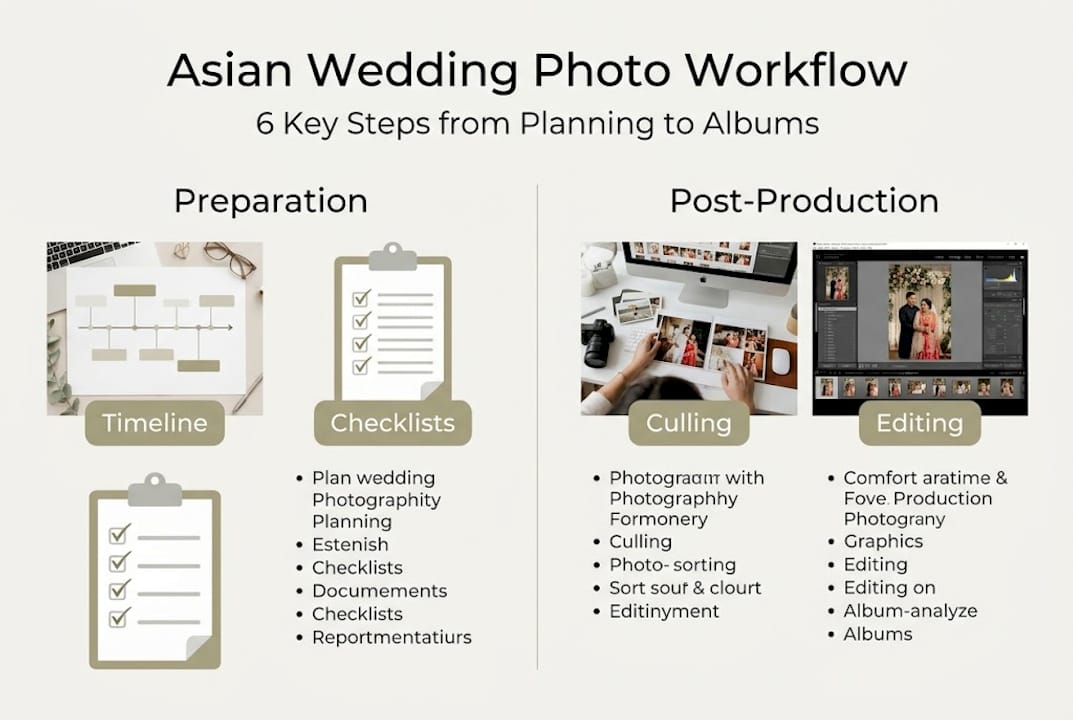
| Workflow stage | Key actions |
|---|---|
| Pre-wedding consultation | Shot list creation, timeline review, venue recce |
| Day-of coverage | Candid storytelling, guided portraits, ritual documentation |
| Immediate backup | Dual card writing, off-site cloud backup |
| Culling | AI-assisted or manual selection of finest images |
| Editing | Batch colour grading, selective retouching |
| Delivery | Private online gallery, typically within 2 to 6 weeks |
Every couple deserves to know exactly what their photographer will cover. When reviewing potential photographers, ensure their workflow includes:
- A dedicated pre-wedding planning meeting
- A written shot list tailored to your specific ceremonies
- Dual-card backup systems for data security
- A clear editing and delivery timeline
- Cultural awareness of your specific traditions
- Transparent communication throughout the process
Pro Tip: Ask any photographer you are considering to share their documented workflow. Comparing these documents side by side is one of the most revealing ways to distinguish a premium specialist from a generalist. Understanding how beauty is captured at Asian weddings begins long before the ceremony itself.
Preparation and planning: Setting up for success
Now that the essentials are clear, it is time to ensure meticulous preparation for the big day. Asian weddings in the UK frequently span multiple days, involve distinct religious ceremonies, and require photographers who genuinely understand the cultural significance of each ritual. UK specialists consistently emphasise cultural sensitivity and multi-day coverage as non-negotiable for Sikh, Hindu, and Muslim weddings.
A thoughtful timeline is your most powerful planning tool. Industry guidance confirms that pre-ceremony preparation typically requires two to three hours for detail shots and candids, followed by the ceremony, family groups of ten to fifteen shots taking around thirty to forty-five minutes, couple portraits in available daylight, and finally the reception. Buffers are essential for delays, large groups, and unexpected cultural moments.
| Time slot | Coverage focus |
|---|---|
| 2 to 3 hours pre-ceremony | Bridal prep, groom prep, detail shots, candid family moments |
| Ceremony | Full ritual documentation, candid emotions, key cultural moments |
| Post-ceremony | Family formals, wedding party portraits |
| Golden hour | Intimate couple portraits |
| Reception | First dance, speeches, candid celebrations |
Here are the numbered planning steps we recommend for every Asian wedding:
- Schedule a detailed pre-wedding meeting at least six weeks before the day
- Walk through every ceremony and identify the five most important moments within each
- Build a written timeline and share it with your venue and all key family members
- Identify a family liaison who can gather guests quickly for group shots
- Discuss lighting conditions at each venue, including indoor mandap or prayer hall settings
- Review traditional Asian photography scenes to inspire your shot list
Pro Tip: Always allocate a minimum of fifteen additional minutes per major cultural ritual. Ceremonies such as the Saat Phere or the Milni can extend unexpectedly, and photography's impact on Asian weddings depends entirely on being present for every heartfelt second.
Executing the perfect wedding day shoot
With all the plans in place, let us see how the workflow unfolds on the actual wedding day. Execution is where preparation meets instinct, and where a skilled photographer earns their reputation.
A typical run sheet for a premium Asian wedding shoot follows this sequence:
- Arrive ninety minutes before bridal preparations begin to capture detail shots: jewellery, lehenga, invitation cards, and heirloom pieces
- Document bridal preparation with a blend of candid storytelling and softly guided portraits
- Move to groom preparation, capturing the Sehra bandi or turban tying with cinematic precision
- Position for the ceremony's opening moments before guests are seated
- Work the room during the ceremony, anticipating emotional reactions from family
- Transition swiftly to family formals immediately after the ceremony ends
- Escort the couple to the pre-scouted portrait location for golden-hour images
- Return for reception coverage, prioritising first dances, speeches, and candid celebrations
The finest results come from blending two distinct approaches. Photojournalistic coverage captures behind-the-scenes moments with raw authenticity, whilst guided portraiture creates the regal, timeless images that couples treasure for generations. Neither style alone is sufficient.
Must-capture moments for Asian weddings include:
- The bride's first look at herself in full bridal attire
- The groom's expression as the bride enters
- The exchange of garlands or Varmala
- Pheras or Saat Phere circling the sacred fire
- The Rukhsati or Vidaai farewell
- Parents' emotional reactions throughout
Critical reminder: Never leave the ceremony space during active rituals. Moments such as the tying of the Mangalsutra or the signing of the Nikah Nama last only seconds. Once missed, they cannot be recreated. Reviewing groom preparation guidance beforehand helps ensure the full story is told from the very first frame.
On-the-day delays are inevitable. When they occur, use the additional time to capture environmental detail shots, candid guest interactions, or supplementary bridal portraits rather than standing idle.
Selection, editing, and personalising your final images
Once the wedding day wraps up, the focus shifts to careful curation and editing. This stage is where raw footage transforms into the polished, emotionally resonant gallery you will revisit for the rest of your lives.
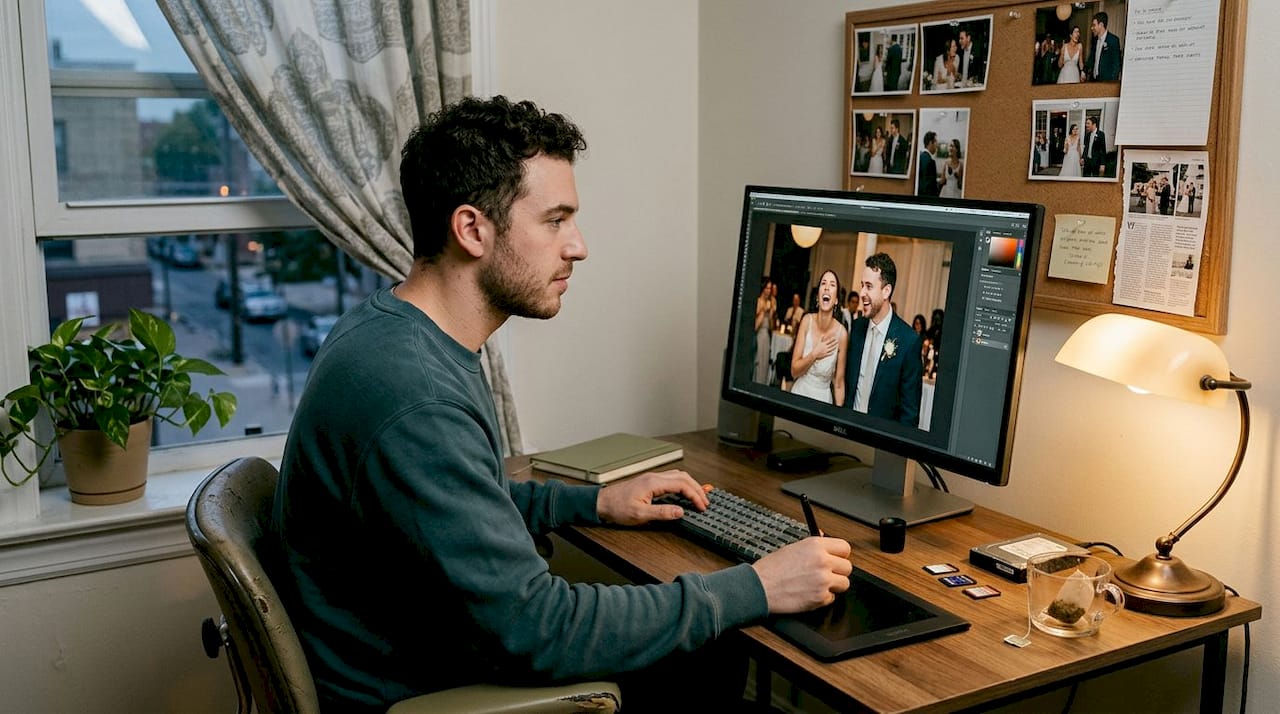
The culling process involves reviewing every image captured and selecting only those that are technically excellent and emotionally compelling. Many photographers now use AI-assisted culling tools to accelerate this stage, though the final selection should always reflect a human artistic eye. Quality over quantity is the guiding principle: a gallery of three hundred extraordinary images far surpasses a thousand mediocre ones.
Batch editing establishes a consistent colour palette and tonal style across the entire gallery. For Asian weddings, this means preserving the extraordinary vibrancy of red and gold bridal attire, the warmth of candlelit mandaps, and the richness of embroidered fabrics. AI-powered editing tools enable premium output at scale, but they must be personalised to avoid generic looks, which is particularly important for the artistic consistency that high-volume Asian wedding coverage demands.
Personal touches that Asian couples particularly value include:
- Careful skin tone preservation across diverse family members
- Vibrant but natural rendering of traditional textiles and embroidery
- Thoughtful black-and-white conversions for emotional ceremony moments
- Subtle enhancement of floral arrangements and decorative details
- Consistent editing across multi-day events for a cohesive visual narrative
Selective retouching goes beyond batch editing to address individual images. This might involve removing a distracting background element, softening harsh shadows on a portrait, or enhancing the luminosity of a bride's expression. Understanding how beauty is captured at this stage requires both technical skill and genuine cultural appreciation.
Pro Tip: Agree on a delivery timeframe in writing before you book. The industry standard is two to six weeks, and any photographer who cannot commit to this should be questioned carefully.
Our perspective: Why your workflow matters more than your camera
Bringing these steps together, let us share what truly sets the finest Asian wedding photographers apart. Here is an opinion that might surprise you: the camera body matters far less than the process behind it.
We have seen technically gifted photographers with extraordinary equipment miss the Vidaai entirely because they had no documented workflow and no cultural briefing. Conversely, we have seen photographers with modest gear produce breathtaking, legacy-worthy galleries because their preparation was immaculate and their cultural understanding was genuine.
Photography's true impact on an Asian wedding is determined by communication, cultural sensitivity, and systematic execution, not megapixels. When you vet photographers, ask to see their planning documents, their shot lists, and their client communication process. A beautiful portfolio shows you what they have achieved. A documented workflow tells you whether they can reliably achieve it for you, on your day, with your specific ceremonies and family dynamics.
Trust the process, not just the pictures.
Bring your dream Asian wedding to life with expert photography
Ready to put this workflow into action for your big day? Choosing a specialist who has refined every stage of this process for Asian weddings is the single most important decision you will make for your photography.
At Rashpal Photography, we have built our entire approach around the cultural richness, emotional depth, and visual grandeur that Asian weddings deserve. From the first planning consultation to the moment your gallery arrives, every step is handled with precision and care. Explore our wedding photography packages to find the coverage that suits your celebration, or review our full pricing to plan with confidence. We would be honoured to tell your story.
Frequently asked questions
How long does it typically take to receive wedding photos after an Asian wedding?
Most premium photographers deliver final galleries within two to six weeks of the wedding day, though complex multi-day Asian weddings may sit towards the upper end of that range.
What should I look for in a premium Asian wedding photographer's workflow?
Prioritise clear planning, genuine cultural sensitivity, a blend of candid and artistic styles, immediate dual-card backups, and a written delivery timeline. UK specialists consistently highlight cultural understanding as the defining quality that separates exceptional Asian wedding photographers from generalists.
How do photographers ensure no important cultural moments are missed during Asian weddings?
By collaborating closely with the couple on a detailed timeline that lists every key ritual, with built-in time buffers for delays and unexpected extensions to ceremonies, ensuring the photographer is always positioned and ready.
Is AI editing reliable for Asian wedding photography?
AI editing tools are highly effective for consistency and efficiency across large galleries, but they must be personalised to preserve the artistic style and cultural vibrancy that Asian weddings demand, rather than producing a generic, one-size-fits-all result.
Recommended
- How The Right Photography Can Make Or Break An Asian Wedding Rashpal Photography | Wedding Photographer Uxbridge, UK
- Top Asian Wedding Photography: Behind the Scenes Rashpal Photography | Wedding Photographer Uxbridge, UK
- Capturing the beauty of an Asian wedding Rashpal Photography | Wedding Photographer Uxbridge, UK
- 6 Ways To Arrive At Your Asian Wedding In Style! Rashpal Photography | Wedding Photographer Uxbridge, UK
- Oahu Wedding Photographer Timeline Planning - Creative Media Production LLC