TL;DR:
- Photojournalistic wedding photography captures genuine, unposed moments that reflect the true emotion and cultural richness of Asian weddings. It relies on observation and minimal direction to create a visual narrative that feels authentic and powerful. Couples who trust their photographer and communicate their priorities will achieve images that beautifully preserve the essence of their special day.
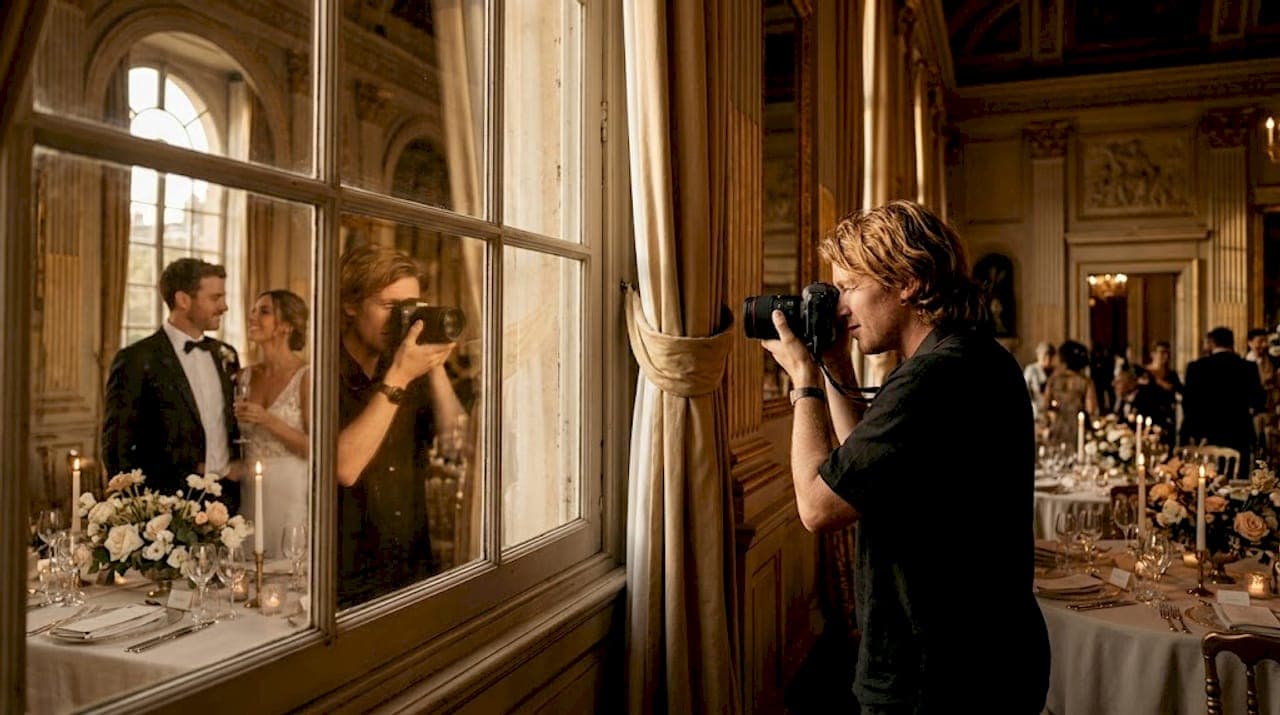
Most couples assume their wedding album will only be as beautiful as the posing routine allows. You spend months imagining the perfect shot, only to realise on the day that the most breathtaking moment was the one nobody directed: a grandmother quietly wiping a tear, the spontaneous laughter shared between siblings during the baraat, the unguarded glance exchanged between two people deeply in love. Photojournalistic photography is built around exactly those moments, and for Asian weddings in the UK, where emotion, ritual, and cultural richness unfold at every turn, this approach can be genuinely transformative.
Table of Contents
- Defining photojournalistic photography
- How does photojournalistic photography work at weddings?
- Photojournalistic photography versus traditional styles
- Why choose photojournalistic photography for Asian weddings?
- Finding your unique style: blending photojournalism and artistry
- What most couples miss about photojournalistic wedding photography
- Explore packages that capture your story
- Frequently asked questions
Key Takeaways
| Point | Details |
|---|---|
| Authentic storytelling | Photojournalistic photography creates a genuine, narrative-driven album capturing true emotions and moments. |
| Minimal posing required | This approach documents the day naturally, with minimal direction for relaxed, authentic results. |
| Blended styles possible | Couples can combine photojournalistic and artistic portraiture for a customised wedding album. |
| Perfect for Asian weddings | Photojournalistic coverage captures the emotion, tradition, and celebration found in multicultural events. |
Defining photojournalistic photography
With the groundwork set, let's explore what actually defines photojournalistic photography. At its core, photojournalistic photography is a form of journalism that uses photographs as the main storytelling tool, documenting real events and communicating information to the public. This definition matters because it draws the distinction between decoration and documentation. A decorative image is arranged; a documentary image is discovered.
"Photojournalistic photography is a form of journalism that uses photographs as the main storytelling tool to document real events and communicate information to the public."
The principles that underpin this approach have remained remarkably consistent since photojournalism emerged in the early twentieth century. They are:
- Accuracy: The image must reflect what genuinely occurred, without staging or manipulation.
- Context: Every photograph tells a story within a larger sequence of events, preserving meaning.
- Authenticity: Emotion, expression, and interaction are captured as they naturally arise.
- Restraint: The photographer's role is to witness and record, not to orchestrate.
In a wedding context, these principles translate into something quietly powerful. Rather than asking the groom to look towards the light for the fifth time, a photojournalistic photographer moves through the room observing, anticipating, and waiting for the moment to arrive on its own terms. The results feel less like a catalogue of images and more like a lived, visual memory of your day.
How does photojournalistic photography work at weddings?
After understanding the foundation, it's important to see how the principles translate into actual wedding coverage. The methodology is elegantly simple: the photographer becomes, as much as possible, invisible. A core methodology in photojournalistic work is observation with minimal to no directing of subjects, aiming to capture genuine reactions and interactions as they naturally unfold.
In practice, this means your photographer will move quietly between spaces, reading body language and emotional cues, positioning themselves before moments peak rather than after. Here is what that typically looks like across your wedding day:
- Pre-ceremony coverage: Your photographer documents the intimacy of preparation, from the delicate application of bridal mehndi to the nervous energy shared between bridesmaids.
- Ceremony documentation: Every ritual is captured with full attention, including reactions from family members who may not realise they are being photographed.
- Candid reception moments: Conversations, laughter, tears, and quiet interludes between guests become the visual fabric of your album.
- Transitions and details: Even the in-between moments, a bride pausing before walking out, a parent adjusting a sherwani, carry profound storytelling weight.
- Emotional peaks: First looks, ring exchanges, and heartfelt speeches are approached with a long lens, preserving the natural quality of the moment from a respectful distance.
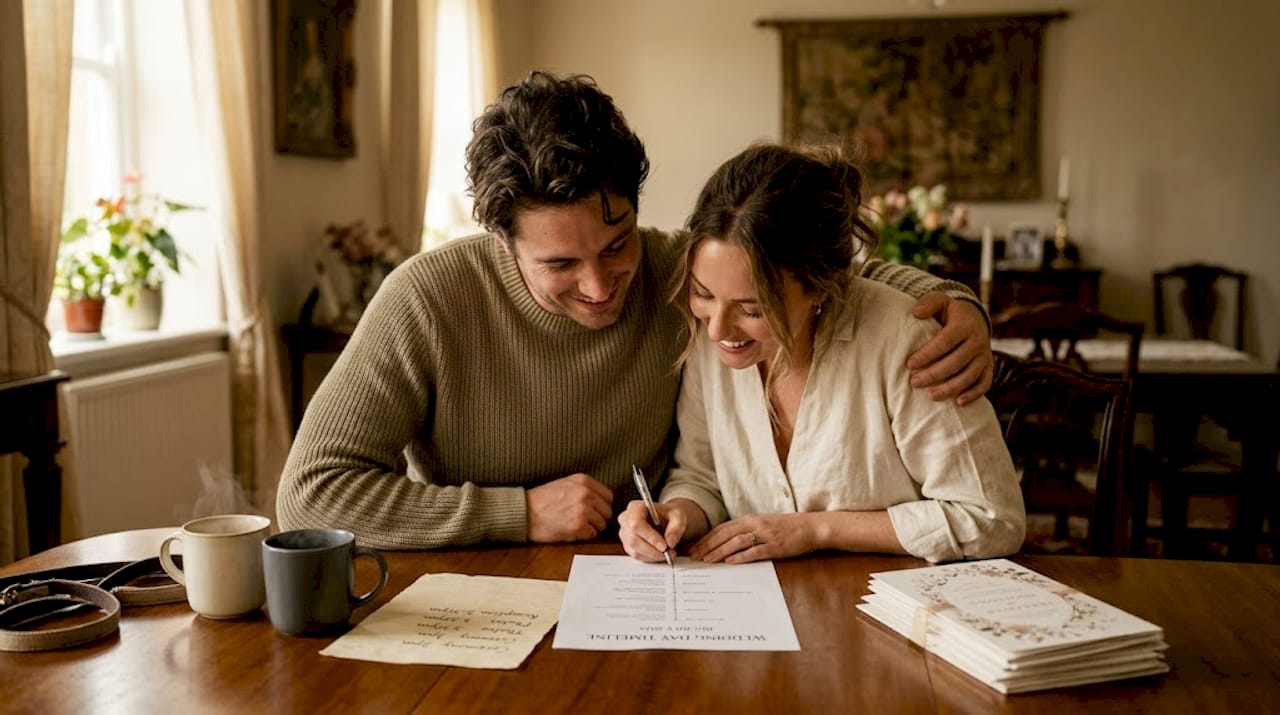
Pro Tip: Before your wedding day, share your schedule with your photographer in detail, including all the rituals you consider most meaningful. This allows them to anticipate pivotal moments and position themselves perfectly without needing to interrupt the flow.
Couples who choose classic wedding coverage spanning the full day benefit most from this approach, as the extended timeline creates space for the quieter, unscripted moments that define great documentary storytelling.
Photojournalistic photography versus traditional styles
To give you a clearer sense of your options, here's how photojournalistic photography compares to typical alternatives. Photojournalistic photography is storytelling-driven coverage that documents the full day as a cohesive narrative, avoiding heavily posed shots. Traditional photography, by contrast, centres on directed portraiture, where poses are choreographed and lighting meticulously arranged.
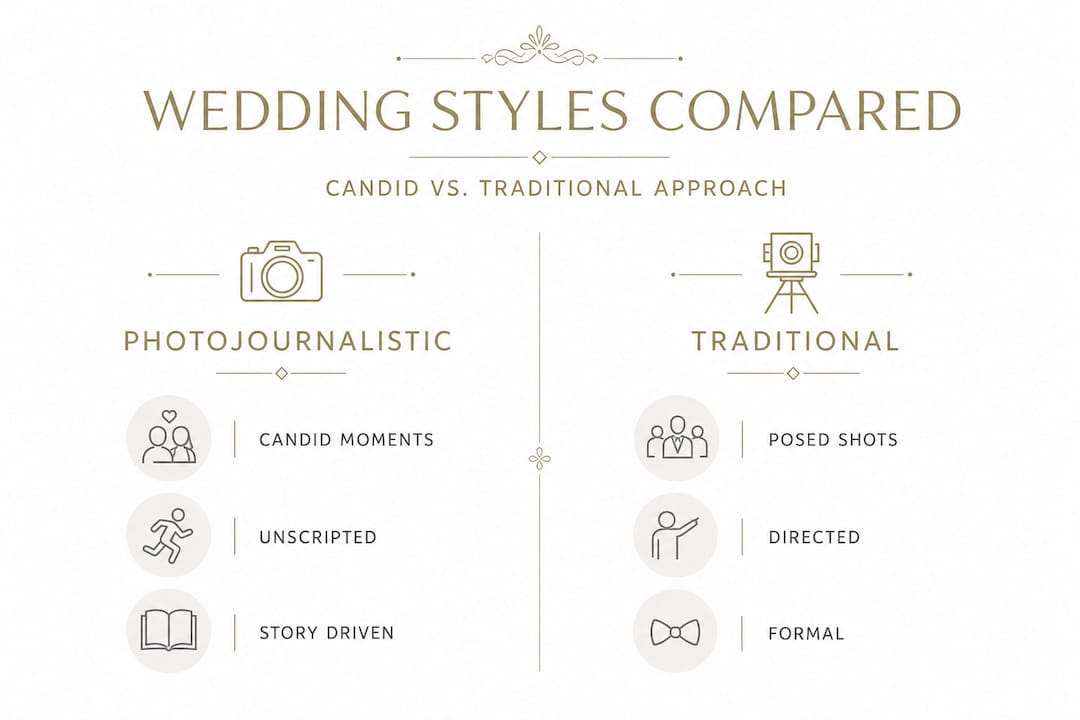
| Style | Direction level | Emotional tone | Best suited for |
|---|---|---|---|
| Traditional posed | High | Formal, polished | Couples who want structured portraits |
| Photojournalistic | Minimal | Authentic, raw | Storytelling and candid coverage |
| Hybrid | Moderate | Balanced | Couples who want both |
| Editorial | High creative | Artistic, cinematic | Fashion-forward, styled imagery |
Both traditional and photojournalistic approaches carry genuine merit. Traditional photography guarantees certain compositional outcomes: everyone is looking the right way, the lighting is flattering, and the framing is intentional. Photojournalistic photography sacrifices some of that control in favour of emotional truth. The image may be less technically perfect, but it is far more likely to make you feel something when you look back at it twenty years from now.
For couples who want complete flexibility, the essentials package style offers a considered balance across a full day, while those who prefer a pared-back experience may find the minimalist wedding photography option particularly well-suited to an intimate celebration.
Pro Tip: When reviewing a photographer's portfolio, look specifically for images that seem to capture a split second of genuine emotion, rather than images where everyone appears to have been placed. This is the clearest indicator of a genuinely photojournalistic sensibility.
Why choose photojournalistic photography for Asian weddings?
Once you understand the spectrum of styles, it becomes clear why photojournalism stands out for multicultural events. Asian weddings are, by nature, layered and rich with ceremony. A Hindu wedding may span multiple days, encompassing the haldi, mehndi, sangeet, wedding ceremony, and reception. A Sikh wedding includes the deeply moving Anand Karaj, where every moment carries spiritual and familial significance. A Muslim Nikah ceremony carries its own intimate gravity. Each of these occasions produces an abundance of unscripted emotional moments that no amount of posing could replicate.
The photojournalistic approach is uniquely suited to this environment because:
- Cultural rituals are inherently photogenic: The vibrant colours of a mehndi ceremony, the sacred stillness of an Anand Karaj, and the exuberant energy of a sangeet stage are all visually compelling without any additional arrangement.
- Family interactions are unrepeatable: The moment a mother sees her daughter dressed for the first time, or a father's expression during the vidaai, cannot be reconstructed.
- Multiple celebrations demand sustained attention: Because Asian weddings span several events, a photographer working documentarily can maintain narrative continuity across the entire occasion.
- Authenticity resonates across generations: The photographs you share with your children and grandchildren should feel like genuine windows into the day, not curated performances.
In established documentary and press contexts, photojournalistic work is judged with criteria oriented around accuracy and authenticity, rather than purely aesthetic considerations. This standard is precisely what makes the approach so valuable for preserving the emotional truth of your wedding day.
Statistic to consider: Research consistently shows that wedding photographs are among the most cherished possessions couples retain decades after the day itself. Images that evoke genuine feeling are referenced and shared far more frequently than formally posed portraits.
If you are considering a relaxed pre-wedding session to build rapport with your photographer before the big day, engagement story sessions offer an ideal opportunity to experience a documentary-led approach in a low-pressure environment.
Finding your unique style: blending photojournalism and artistry
Understanding the advantages leads naturally to choosing the right style for your day. Clarifying whether you want near-zero direction or a hybrid approach that adds limited portraits is one of the most important conversations you can have with your photographer before the wedding.
Not every couple wants a strictly documentary experience. Many find that a thoughtfully blended approach, combining candid storytelling with a small number of artistically guided portraits, produces an album that is both emotionally resonant and visually refined. Here is a practical framework for deciding:
- Identify your priorities: Do you value raw emotion above all, or is a certain level of compositional polish important to you?
- Review portfolios carefully: Look at full wedding galleries, not just highlight images, to understand how a photographer balances styles.
- Discuss your must-have shots: Certain family groupings or cultural portraits may be non-negotiable; communicate these clearly.
- Consider the venue: Some locations lend themselves to extraordinary guided portraiture, while others are better suited to pure documentary coverage.
| Approach | Guided portraits | Candid coverage | Album feel |
|---|---|---|---|
| Pure photojournalistic | Minimal | Extensive | Narrative, lived-in |
| Balanced hybrid | Moderate | Strong | Elegant and authentic |
| Artistic led | Significant | Some | Cinematic, editorial |
The silver engagement package is an excellent way to test a blended approach before your wedding day. A relaxed session together allows you to experience what it feels like to be guided gently into moments, rather than posed rigidly, and to see how naturally candid images emerge alongside more intentionally crafted ones.
What most couples miss about photojournalistic wedding photography
Having reviewed style choices, it's time for some industry perspective on what actually leads to standout wedding photos. Here is something most articles in this space do not say directly: the quality of your wedding photographs is not solely the photographer's responsibility. It is a shared achievement.
Many couples arrive at their wedding day with a fixed idea that photojournalistic means hands-off, and that they simply need to show up and live the day. That instinct is largely correct, but it overlooks something essential: the relationship between you and your photographer profoundly shapes what becomes possible. When trust is established before the day, when your photographer knows which moments matter most to you, when you feel genuinely comfortable in their presence, then the images shift from merely candid to deeply meaningful.
The most common mistake is treating the style conversation as a one-time checkbox during the booking process. In reality, great documentary wedding photography emerges from an ongoing creative dialogue. Share family dynamics your photographer should be aware of. Tell them which rituals move you most. Let them know if certain family members are camera-shy. These details allow a skilled photographer to navigate the day with both sensitivity and intention, knowing precisely when to step forward and when to disappear entirely.
There is also a tendency to assume that a strict no-direction policy will yield the most authentic results. In our experience, that is not always true. Occasionally, a gentle suggestion, repositioning slightly into better light, or a quiet prompt to look towards a loved one, produces an image that feels utterly natural while being technically superior. This is the craft of the hybrid approach, and it requires both skill and restraint to execute with integrity.
The couples who walk away with the most extraordinary wedding albums are those who entered the day relaxed, trusting their photographer implicitly, and present in every moment. The camera, at its finest, simply bears witness to what love already looks like.
Explore packages that capture your story
With clarity about your preferred style, you can now move from inspiration to booking. At Rashpal Photography, we specialise in exactly the kind of refined, emotionally intelligent wedding coverage this guide describes: a blend of authentic documentary storytelling and considered artistic portraiture, tailored to the unique beauty of Asian weddings.
Whether you are drawn to the immersive narrative of a full day Classic Investment package or are exploring the breadth of what's possible through our Weddings portfolio, we invite you to take the next step with confidence. Every package is designed to honour your culture, your love story, and the irreplaceable moments that make your day entirely your own. See all pricing and find the option that feels right for you.
Frequently asked questions
Can I mix photojournalistic and traditional photography at my wedding?
Yes, many couples choose a blend to enjoy both candid moments and planned portraits, as documentary and photojournalistic styles represent the candid end of a spectrum that can be thoughtfully combined with more structured approaches.
Will I get family group shots with a photojournalistic photographer?
You can absolutely request group shots; simply discuss these priorities with your photographer before the day so they can allocate time and ensure no important family portrait is overlooked.
How does photojournalistic photography capture emotion?
By focusing on genuine interactions, photographers document real reactions as they unfold, using observation with minimal direction to preserve the natural quality of every significant moment.
Is photojournalistic wedding photography suitable for Asian ceremonies?
Yes, it is particularly well-suited to multicultural events, as the approach creates a cohesive visual narrative across multiple celebrations, capturing authentic rituals and unscripted emotional moments with full sensitivity and care.
Recommended
- Top Tips For Camera Shy Couples Rashpal Photography | Wedding Photographer Uxbridge, UK
- Classic Investment (14 Hours, 1 day, Engagement Shoot) Rashpal Bhachu | Rp photography Wedding Photographer, Uxbridge, UK
- Silver Engagement Shoot Rashpal Bhachu | Engagement shoots Wedding Photographer, Uxbridge, UK
- The Minimalist Investment (8 Hours) Rashpal Bhachu | Rp photography Wedding Photographer, Uxbridge, UK