
TL;DR:
- The London Asian wedding community is a diverse collection of cultural groups, each with unique traditions and logistics. These multi-day celebrations involve significant planning around venues, caterers, and religious rituals, often within specific geographic clusters like Southall and Wembley. Success depends on understanding community-specific customs, trusted referral networks, and coordinating with specialist vendors to ensure authentic and memorable events.
The London Asian wedding community is one of the most culturally rich and logistically complex wedding networks in the world, encompassing Punjabi Sikh, Gujarati Hindu, Pakistani Muslim, South Indian, Sri Lankan, and Persian communities, each with distinct rituals, venues, and culinary traditions. Understanding how this community operates is the difference between a wedding that feels authentic and one that feels assembled. London's multicultural fabric makes it uniquely positioned to host these celebrations at scale, with dedicated venue clusters, specialist caterers, and trusted referral networks that have developed over decades. This guide explains the key components of the London Asian wedding community so you can plan with clarity and confidence.
What is the London Asian wedding community explained?
The London Asian wedding community is not a single group. It is a collection of distinct cultural communities, each with its own ceremonial structure, religious requirements, and social expectations, all operating within the same city. Punjabi Sikh weddings centre on the Anand Karaj ceremony held within a Gurdwara. Pakistani Muslim weddings follow a sequence of Mehndi, Nikah, Baraat, and Walima. Gujarati Hindu weddings incorporate fire rituals and multi-day family gatherings. South Indian and Sri Lankan Tamil weddings bring their own temple protocols and regional cuisines.
What unites these communities is the scale and significance of the celebration. Asian weddings in London generally involve guest counts ranging from 200 to 800, depending on the ceremony type. That scale shapes every decision, from venue selection to catering logistics to photography coverage. The community also operates on deep trust networks, where recommendations from family and friends carry far more weight than any advertisement.
What are the main cultural traditions that shape Asian weddings in London?
Asian wedding traditions in London are structured around specific ceremonies, each carrying religious and cultural weight. Understanding the sequence and significance of each event is the foundation of good planning.
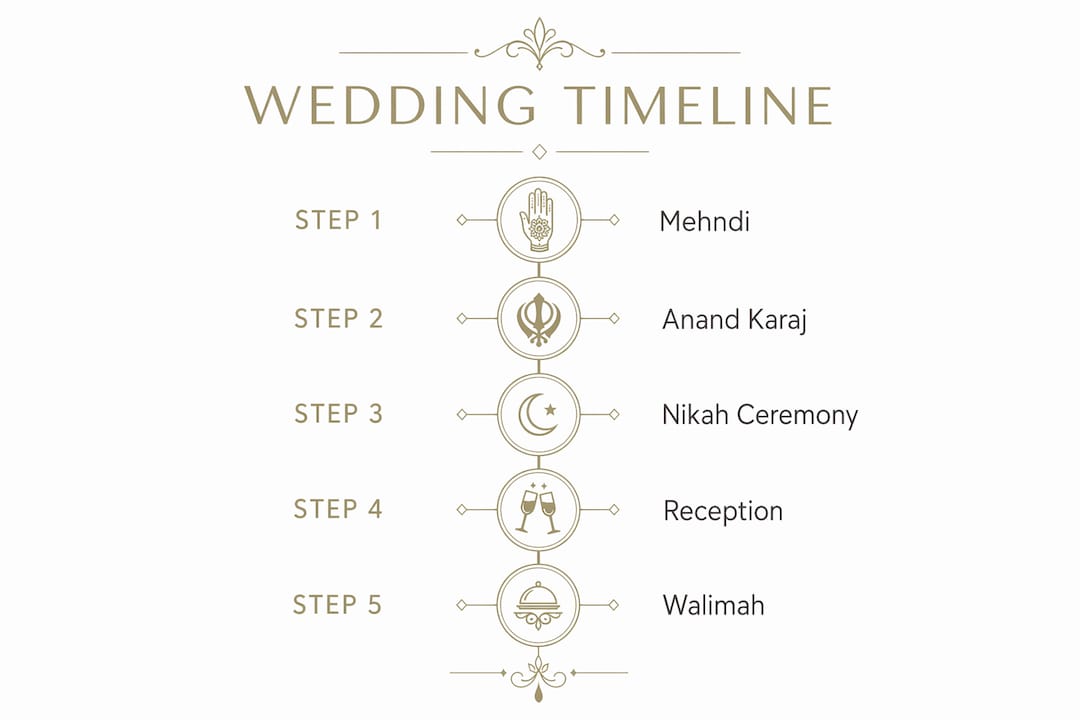
The most common ceremonies across London's Asian wedding community include:
- Mehndi: A pre-wedding celebration where intricate henna patterns are applied to the bride's hands and feet, accompanied by music and dancing. Held one to two days before the main ceremony.
- Nikah: The Islamic marriage contract ceremony. The Nikah typically lasts 20–40 minutes and is attended by a more intimate gathering of 120–250 guests.
- Baraat: The groom's procession to the wedding venue, often accompanied by a dhol drummer and large family group. Pakistani Baraat celebrations require venues for 300–700 guests.
- Walima: The post-wedding reception hosted by the groom's family, typically held the day after the Nikah and Baraat.
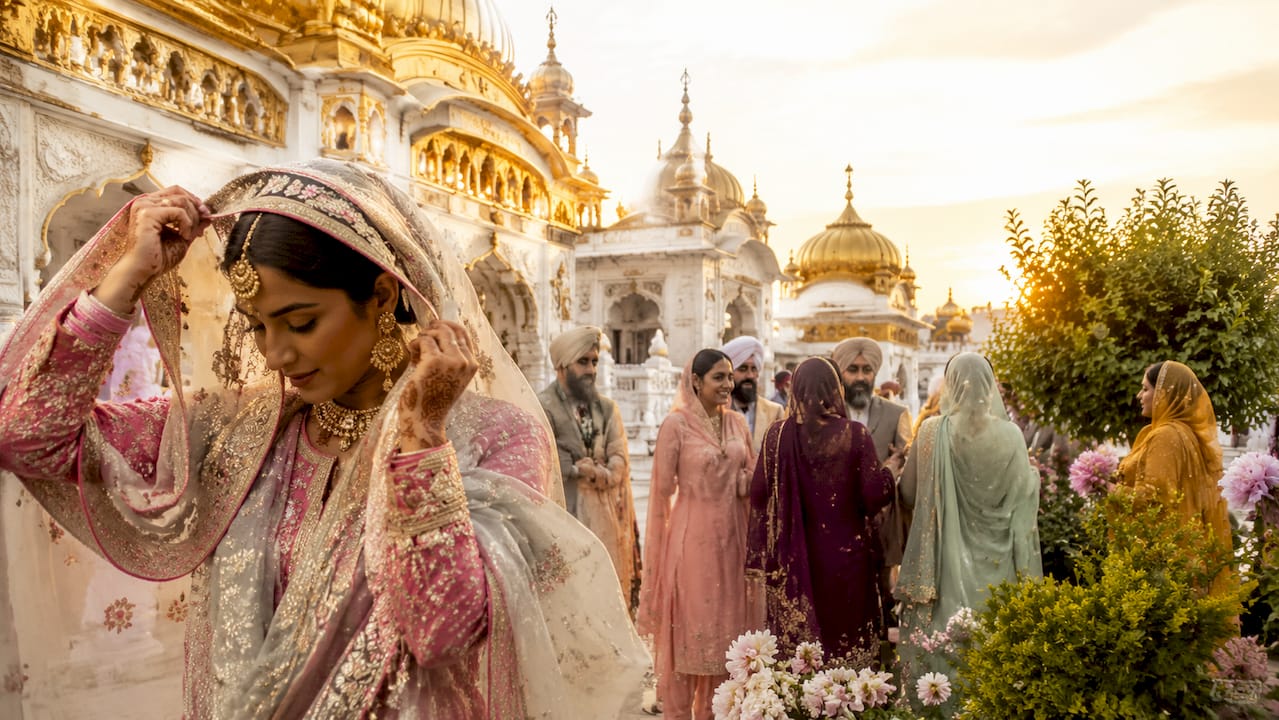
- Anand Karaj: The Sikh wedding ceremony conducted inside a Gurdwara, with four ceremonial circumambulations of the Guru Granth Sahib. Photography protocols within the Gurdwara are strict and require advance permission.
- Sofreh Aghd: The Persian ceremonial spread, laden with symbolic items including mirrors, candles, herbs, and sweets. A Persian Sofreh Aghd integrated with modern venue design demonstrates how ancient ritual and contemporary aesthetics can coexist beautifully.
Multi-day timelines are the norm rather than the exception. The gap between events is not simply downtime. It is a logistical necessity for venue reset, staff changeover, and managing the social obligations of hundreds of guests across multiple family groups.
Pro Tip: If you are attending a Sikh Anand Karaj for the first time, cover your head before entering the Gurdwara and remove your shoes at the entrance. Arriving late disrupts the ceremony and is considered disrespectful.
The distinction between religious and cultural customs matters enormously. A Nikah is a religious requirement; the Walima banquet is a cultural expression of celebration. Knowing which elements are non-negotiable and which are flexible gives you far greater planning freedom.
Where are the key geographic clusters for Asian weddings in London?
London's Asian wedding venues are concentrated in specific boroughs, shaped by decades of community settlement patterns. Knowing where these clusters are saves time and connects you to suppliers who understand your cultural requirements.
| Area | Community focus | Key features |
|---|---|---|
| Southall, West London | Punjabi Sikh | Multiple Gurdwaras, specialist bridal shops, Punjabi caterers |
| Wembley, North West London | Gujarati Hindu | Large banqueting halls, vegetarian caterers, Hindu mandap specialists |
| East London (Whitechapel, Ilford) | Bengali and Pakistani Muslim | Halal banqueting suites, close to mosque facilities |
| Croydon, South London | South Asian Muslim | Dedicated Muslim wedding venues, Halal catering |
| Edmonton, North London | South Asian and East African Asian | Community halls, multi-purpose banqueting spaces |
Southall remains the spiritual and commercial heart of the Punjabi Sikh wedding world in London. The high street offers everything from bridal lehenga boutiques to specialist sweet shops for wedding favours. Wembley serves the Gujarati community with large venues capable of hosting elaborate mandap ceremonies and fully vegetarian menus. The top Asian wedding venues in London reflect these geographic concentrations directly.
Geography also influences catering choices. A venue in Southall will have established relationships with Punjabi caterers. A venue in Wembley will have preferred Gujarati vegetarian suppliers. Working within these local ecosystems reduces friction and often improves quality, because the relationships between venues and their preferred suppliers have been refined over years.
How does Asian wedding catering in London reflect community diversity?
Asian wedding catering in London is not a single category. It is a collection of distinct culinary traditions that require specialist knowledge, and treating them as interchangeable undermines the authenticity of your celebration. Asian catering is not a monolith: Punjabi, Gujarati, Tamil, and Sri Lankan cuisines differ significantly in ingredients, cooking techniques, and service styles.
Key considerations for catering your London Asian wedding:
- Dietary requirements: Halal certification is non-negotiable for Muslim weddings. Gujarati Hindu weddings are typically fully vegetarian, and many guests will also require Jain-friendly options with no root vegetables. Tamil and Sri Lankan menus often feature distinct spice profiles and rice-based dishes that differ entirely from North Indian cuisine.
- Menu authenticity: A caterer who specialises in Punjabi cuisine will not produce an authentic Sri Lankan spread. Matching the caterer to the specific cultural cuisine is the single most important catering decision you will make.
- Service and timing: Attentive staff managing family-specific requests and service flow are as critical as the food itself. A beautifully prepared menu served at the wrong moment, or by staff unfamiliar with the ceremony structure, will diminish the experience.
- Multi-cuisine weddings: Intercultural weddings, such as a Punjabi and Tamil union, require two specialist caterers or a single caterer with verified expertise in both traditions. This is logistically complex but entirely achievable with careful planning.
Pro Tip: Ask your caterer for references from weddings of the same cultural background as yours, not just Asian weddings in general. A caterer with ten Punjabi wedding references is not automatically qualified to cater a Tamil Brahmin ceremony.
The one-size-fits-all catering myth is one of the most common and costly mistakes couples make. Specialist caterers who understand your specific tradition will always produce a more authentic and memorable result than a generalist who claims to cover all Asian cuisines.
What practical considerations should couples know when planning an Asian wedding in London?
Planning a London Asian wedding requires attention to logistics that most generic wedding guides never address. The following considerations are specific to the scale and structure of Asian wedding celebrations.
-
Understand your venue's supplier policy. London Asian wedding venues often operate with preferred or exclusive supplier lists. Bringing an outside caterer may incur corkage or kitchen fees. Read your contract carefully and negotiate terms before signing.
-
Build in logistical buffers between ceremonies. The gap between a Nikah and a Baraat, or between a Mehndi and a wedding morning, is not simply rest time. It is essential for venue reset and staff changeover. Underestimating this time creates a cascade of delays that affects every subsequent event.
-
Rely on trusted community referrals. The London Asian wedding community operates on high-trust referral networks. A recommendation from a family member who used a particular florist, caterer, or photographer carries more weight than an online review. Ask recently married couples in your community for their honest assessments.
-
Plan guest transport and accommodation early. With guest counts of 200–800, transport logistics are significant. Many London Asian wedding venues are not easily accessible by public transport, particularly in areas like Southall or Edmonton. Arranging coaches or providing clear parking information prevents unnecessary stress on the day.
-
Book your photographer with cultural awareness in mind. A photographer who has never worked within a Gurdwara, or who does not understand the significance of the Baraat procession, will miss the moments that matter most. Specialist knowledge of Asian wedding photography is not a luxury. It is a requirement.
Key takeaways
The London Asian wedding community is defined by cultural specificity, and every planning decision, from venue to caterer to photographer, must reflect the particular traditions of your community rather than a generic Asian wedding template.
| Point | Details |
|---|---|
| Cultural specificity matters | Punjabi, Gujarati, Tamil, and Pakistani weddings each require distinct venues, caterers, and ceremony knowledge. |
| Venue geography shapes planning | Southall, Wembley, and East London clusters connect you to community-specific suppliers and spaces. |
| Catering requires specialist matching | Assign caterers by specific cultural cuisine, not by a broad Asian catering label. |
| Multi-day logistics need buffers | Build time between ceremonies for venue reset, staff changeover, and guest management. |
| Referral networks are the most reliable resource | Community recommendations outperform online reviews for finding trusted vendors. |
My perspective on what makes London Asian weddings truly memorable
Having photographed Asian weddings across London for many years, I have observed one consistent truth: the couples who experience the most meaningful celebrations are those who resist the pressure to homogenise their wedding for the sake of convenience. London's multicultural fabric is extraordinary. You can hold a Sikh Anand Karaj in Southall in the morning and a Baraat reception in a grand Wembley banqueting hall in the evening, and both will feel entirely authentic if you have chosen the right team.
What I find most striking is how the community's trust networks function as a quality filter. The florist, the caterer, the photographer who comes recommended by three separate families is almost always exceptional. That social accountability produces a standard of service that no amount of advertising can replicate.
The tension I see most often is between families who want to honour every traditional element and couples who want to incorporate modern aesthetics. My honest view is that these goals are not in conflict. A Persian Sofreh Aghd can be styled with contemporary floral arrangements without losing its symbolic depth. A Sikh Anand Karaj can be followed by a reception with a live band and a photobooth. The traditions are resilient. They do not need to be protected from modernity. They need to be understood and respected, and then you are free to build around them.
The National Asian Wedding Show is one of the best places to encounter the full breadth of this community's creativity in a single afternoon. I recommend it to every couple I work with, regardless of their cultural background.
— Rashpal
Capture every ceremony with Rashpal-photography
Asian weddings in London unfold across multiple days, multiple venues, and multiple ceremonies, each carrying its own visual language and emotional weight. Rashpal-photography specialises in capturing this full arc, from the intimate artistry of a Mehndi to the cinematic grandeur of a Baraat procession. Every package is designed with the scale and cultural complexity of Asian weddings in mind. The Classic Investment package offers 14 hours of coverage with an engagement shoot, ideal for full multi-ceremony days. For couples seeking a refined introduction to the portfolio, the wedding photography services page outlines every option in detail. Reach out to discuss your specific cultural requirements and secure your date.
FAQ
What ceremonies are included in a typical London Asian wedding?
A typical London Asian wedding includes pre-wedding events such as Mehndi, followed by the main religious ceremony (Anand Karaj, Nikah, or Hindu wedding rituals), and a reception or Walima. The exact sequence varies by cultural and religious background.
How many guests attend a London Asian wedding on average?
Guest counts range from 200 to 800, depending on the ceremony type and community. Pakistani Baraat celebrations typically require venues for 300–700 guests, while Nikah ceremonies are more intimate at 120–250.
Why does Asian wedding catering require a specialist caterer?
Asian catering covers distinct culinary traditions including Punjabi, Gujarati, Tamil, and Sri Lankan cuisines, each requiring different ingredients, techniques, and dietary compliance. A generalist caterer cannot authentically serve all of these traditions.
Which areas of London are best for Asian wedding venues?
Southall is the centre for Sikh Gurdwara weddings, Wembley serves the Gujarati community, and East London boroughs including Whitechapel and Ilford host many Muslim banqueting venues. Each cluster has established supplier networks aligned to its community.
Can I bring my own caterer to a London Asian wedding venue?
Many London Asian wedding venues have preferred or exclusive supplier arrangements. Bringing an outside caterer may incur additional corkage or kitchen fees, so review your contract and negotiate terms before committing to a venue.
Recommended
- Newly engaged? Here’s how to start your Asian wedding planning! Rashpal Photography | Wedding Photographer Uxbridge, UK
- 6 Ways To Arrive At Your Asian Wedding In Style! Rashpal Photography | Wedding Photographer Uxbridge, UK
- Best Locations For An Asian Wedding In London Rashpal Photography | Wedding Photographer Uxbridge, UK
- The National Asian Wedding Show Rashpal Photography | Wedding Photographer Uxbridge, UK