TL;DR:
- Editorial wedding portraits blend candid moments with magazine-polished composition, emphasizing strategic timeline management, micro-direction, and natural light. Protecting dedicated portrait windows and employing precise cues result in authentic, editorial-quality images that reflect the couple's beauty and culture. Thoughtful venue selection and deliberate light control further support a cohesive, visually diverse storytelling approach.
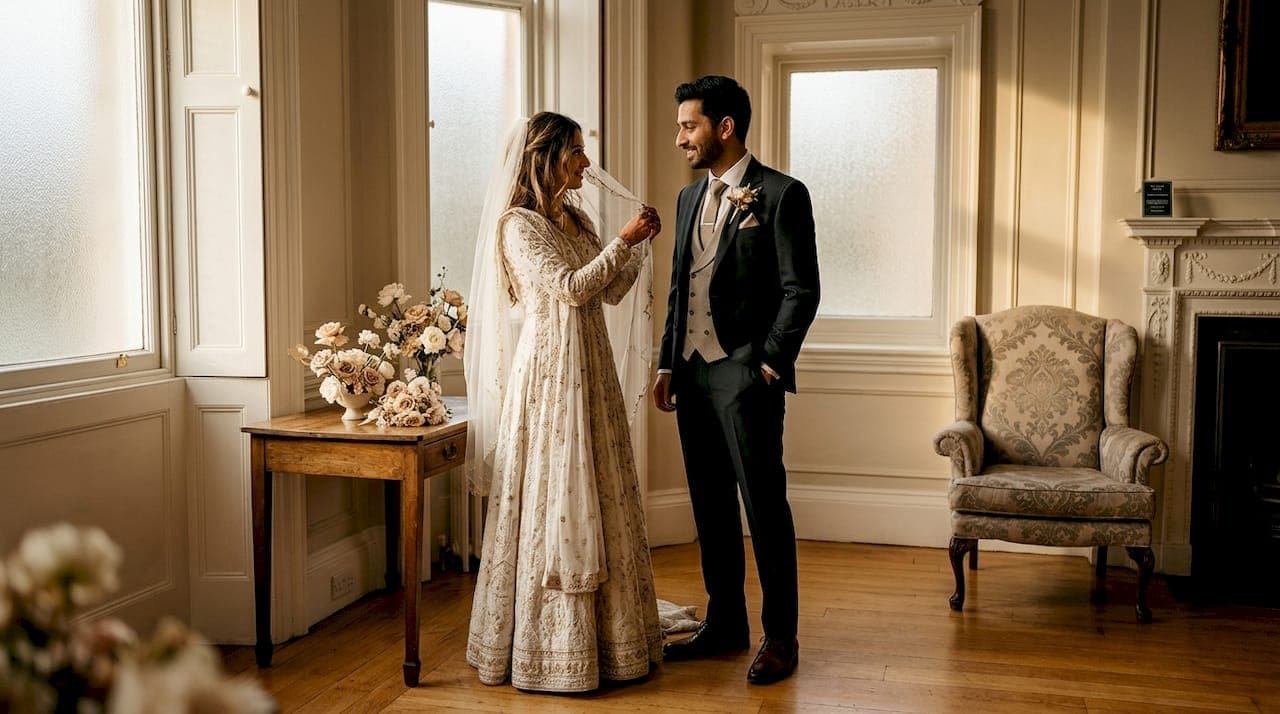
Editorial wedding photography is defined as the practice of guiding couples into natural moments while maintaining considered composition and light, producing images that feel simultaneously candid and magazine-polished. Knowing how to style editorial wedding portraits means mastering three disciplines at once: timeline management, purposeful micro-direction, and creative use of natural light. This guide covers each discipline in precise, practical detail, drawing on techniques used by Rashpal-photography to create cinematic, timeless portraits for Asian weddings and cultural ceremonies across London and beyond.
How to style editorial wedding portraits: preparing your timeline
The single greatest threat to editorial portrait quality is a compressed timeline. When the schedule slips, the first casualty is always the creative portrait session. The solution is to build two 15 to 20 minute buffer pockets into the wedding day specifically to protect portrait opportunities, not simply to absorb delays.
The most reliable approach is to schedule your "hero couple" portraits early in the day, before the ceremony if possible, or during a first look. This guarantees at least one polished set of images regardless of what happens later. Portraits captured after dinner, when the light has faded and energy has shifted, carry a different, often more intimate quality. Both windows serve distinct editorial purposes, and protecting both is worth the planning effort.
Pro Tip: When working with your photographer and wedding planner, ask for portrait windows to be labelled as non-negotiable in the printed timeline. Treat them with the same weight as the ceremony itself.
Consider structuring your portrait time around these key moments:
- First look or pre-ceremony: Ideal for calm, romantic portraits with fresh styling and natural light.
- After the ceremony, before the reception: A brief 15 to 20 minute window for couple portraits while guests enjoy drinks.
- After dinner: Softer, more atmospheric portraits using interior lighting or evening ambience.
- Buffer pockets: Two dedicated windows of 15 to 20 minutes each, built in to absorb schedule drift and allow creative iteration.
A well-protected timeline is not a luxury. It is the structural foundation that makes every other editorial styling decision possible.
What micro-direction techniques produce natural editorial poses?
Micro-direction is the art of giving brief, specific physical cues that produce natural-looking movement without the stiffness of traditional posing. Short, one-breath cues are far more effective than vague encouragement such as "look natural" or "just relax," which invariably produce the opposite result.
For grooms, the most effective technique involves hands-to-task adjustments: asking him to adjust his tie, check his cufflinks, or smooth his jacket lapel. These micro-movements create dynamic hand positioning and add a sense of purposeful elegance to the frame. The result reads as high-fashion body language rather than a staged pose.
Gaze sequencing is equally powerful. Alternating the groom's gaze from direct to camera, then to an off-camera point, then to a natural smile prompted by brief conversation, yields a sequence of authentic expressions. Each frame tells a slightly different story, giving the final edit genuine editorial variety.
For bridal portraits, the following sequence of micro-direction cues works consistently well:
- Shoulder turn: Ask the bride to angle her shoulders 45 degrees away from the camera, then turn her face back towards the lens. This creates depth and a slimming silhouette.
- Chin lift: A gentle upward tilt of the chin elongates the neck and catches light beautifully, particularly with window light from above.
- Bouquet positioning: Lower the bouquet slightly below the waist rather than holding it at chest height. This opens the torso and reveals the gown's bodice detail.
- Weight shift: Ask her to transfer her weight to her back foot. This creates a natural hip curve and prevents the flat, symmetrical stance that reads as stiff in photographs.
- Conversational prompt: Ask a genuine question about the day or the partner. The resulting expression is unguarded and warm, which no posed smile can replicate.
Pro Tip: Avoid giving more than one instruction at a time. Deliver a single cue, allow the subject to settle, capture the frame, then move to the next direction. This rhythm keeps the session feeling relaxed rather than clinical.
How does window light shape bridal portrait styling?
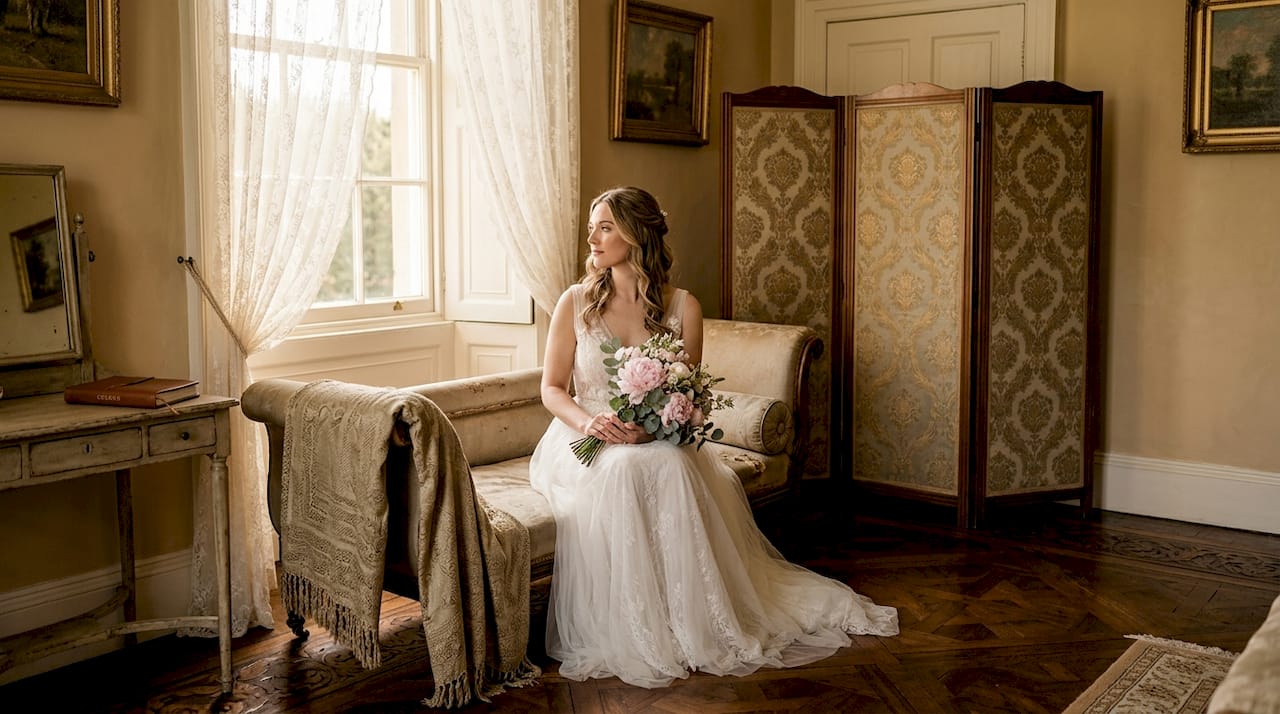
Window light is the most versatile and accessible tool in editorial bridal portrait photography. Different window placements create entirely distinct editorial looks, from luminous brightness to sculptural drama, without any additional equipment.
The three primary window light positions each serve a different creative purpose:
| Light placement | Effect | Best used for |
|---|---|---|
| Head-on (bride faces window directly) | Even, bright, flattering illumination | Soft, romantic editorial portraits |
| 45-degree angle (bride at quarter turn to window) | Dimensional shadow and depth | Fashion-forward, structured portraits |
| Back or rim lighting (window behind bride) | Glowing outline, dramatic separation | Artistic, high-contrast editorial images |
Short lighting, where the shadow side of the face is turned towards the camera, is particularly effective for editorial bridal portraits. It creates a slimming, sculpted quality that reads as sophisticated rather than simply flattering.
Managing exposure with a white wedding gown requires care. Stopping down to approximately f/2.5 to f/2.8 controls the spread of light and preserves the intricate texture and embroidery detail in the fabric. Overexposing a white gown destroys that detail permanently, and no amount of post-processing recovers it. A reflector positioned opposite the window fills shadows gently without flattening the dimensional quality that makes editorial portraits distinctive.
Pro Tip: If the window light is too harsh, diffuse it with a sheer white curtain or a translucent diffusion panel. This softens the quality of light without reducing its directionality, maintaining that editorial depth.
Which venues and backdrops support editorial wedding portrait styling?
Venue selection is itself a styling decision. Venues with natural light, architectural character, and multiple distinct areas provide the variety needed for a full editorial portrait set without requiring location changes, which consume precious time on a wedding day.
Heritage properties, boutique hotels, and rental estates with ornate interiors offer what generic ballrooms cannot: textured walls, grand staircases, arched doorways, and moody corridors that each function as a distinct backdrop. A single venue with five architecturally varied spaces effectively gives you five different portrait settings within a ten-minute walk.
When scouting a venue before the wedding day, look for these qualities:
- Varied light environments: Rooms with large windows, darker corridors, and outdoor terraces each create different tonal moods.
- Textural surfaces: Exposed brick, carved stone, aged timber, and ornate plasterwork all add visual richness without competing with the couple.
- Uncluttered sight lines: Backgrounds with clean lines or soft depth of field allow the couple to remain the clear focal point.
- Colour palette coherence: Neutral or warm tones in the venue complement most bridal colour schemes without clashing.
Choosing a venue with multiple complementary light environments reduces setup time between portrait sets and supports the kind of stylistic diversity that defines editorial wedding photography. The venue is not merely a backdrop. It is a collaborator in the visual narrative.
How to maintain editorial quality under wedding day time pressure
Speed and quality are not opposites in editorial wedding photography. The key is a structured approach that secures essential frames in the first 10 to 15 minutes, then iterates creatively if additional time allows.
The following sequence forms a reliable "secure set" for any portrait session:
- Full-length portrait: Establishes the complete look, gown, and setting in a single definitive frame.
- Three-quarter portrait: Brings the viewer closer, emphasising the face, upper body, and bouquet or hands.
- Back or half-turn: Reveals the gown's back detail, train, or veil, and creates a sense of movement and narrative.
- Movement frame: Ask the couple to walk slowly towards or away from the camera, or for the bride to turn gently. Motion adds life to the sequence.
Once these four frames are secured, the session has editorial coverage regardless of what happens next. If buffer time exists, this is the moment to experiment with more creative compositions, unusual angles, or environmental details that add depth to the story.
Lens choice matters for both speed and aesthetics. A 35mm or 50mm prime lens at f/2 to f/2.8 works efficiently in varied light conditions and produces the flattering perspective that editorial portraits require. Longer focal lengths such as 85mm or 135mm compress the background beautifully and are worth using when time and space allow.
Pro Tip: Establish your colour grade and retouching style before the wedding day, not after. A consistent editing workflow applied to a well-exposed set of images produces a unified, magazine-quality gallery far more efficiently than correcting inconsistent exposures in post-production.
Key takeaways
Editorial wedding portraits succeed when timeline protection, precise micro-direction, and creative light control work together as a unified approach rather than separate techniques.
| Point | Details |
|---|---|
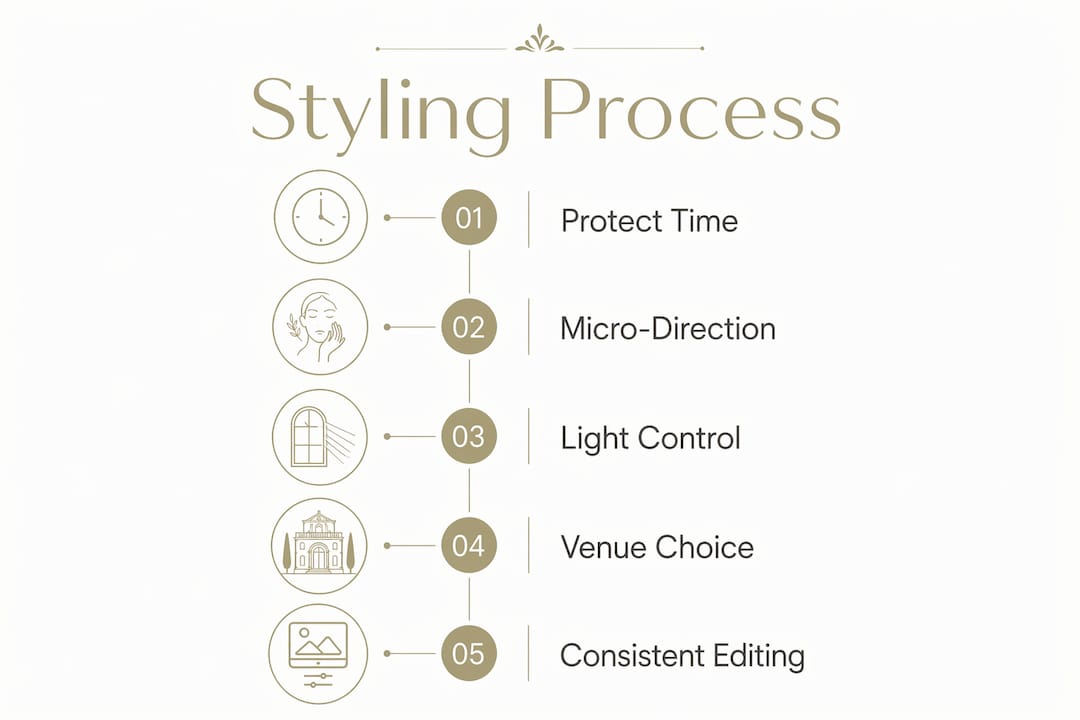
| Protect portrait time | Build two 15 to 20 minute buffer pockets into the timeline to preserve creative portrait opportunities. |
| Use micro-direction precisely | Short, single-breath cues and hands-to-task adjustments produce natural, editorial body language. |
| Control window light deliberately | Choose head-on, 45-degree, or rim lighting positions to create distinct editorial moods from a single source. |
| Select venues with variety | Heritage properties and boutique hotels offer multiple distinct backdrops without requiring location changes. |
| Secure essential frames first | Complete a full-length, three-quarter, back-turn, and movement sequence in the first 10 to 15 minutes. |
What I have learned about editorial portrait styling
After years of photographing Asian weddings and cultural ceremonies across London, I have come to believe that the most common mistake in editorial wedding portraiture is not technical. It is philosophical. Many photographers either over-direct, producing images that look staged and hollow, or under-direct, hoping that beautiful moments will simply appear. Neither approach produces the balanced directing that editorial portraits genuinely require.
The approach that consistently produces the strongest results is what I think of as "structured spontaneity." You create the conditions for a genuine moment, through a precise cue, a well-chosen location, and a considered light source, and then you step back and let the couple inhabit that space naturally. The camera captures what follows. The result feels effortless to the viewer, but every element of it was intentional.
I have also found that couples who understand the process produce better portraits. When a bride knows that a chin lift and a shoulder turn will make her look extraordinary, she does not feel self-conscious about being directed. She feels confident. That confidence reads in every frame. My advice to every couple I work with is to learn the basics of posing before the wedding day, not to become a model, but to feel at ease in front of the lens. That ease is the foundation of every great editorial portrait I have ever made.
— Rashpal
Bring your editorial portrait vision to life with Rashpal-photography
Rashpal-photography specialises in creating cinematic, editorial wedding portraits that honour the beauty, culture, and emotion of your day. Whether you are planning an intimate ceremony or a grand cultural celebration, the studio's packages are designed to accommodate dedicated portrait sessions, creative styling, and the timeline flexibility that editorial work demands.
Explore the full-day wedding packages that include engagement shoots and extended portrait sessions, or browse the complete weddings portfolio to see editorial styling in practice across a range of venues and cultural ceremonies. Every package is built around a personalised approach, because no two weddings, and no two couples, are ever the same.
FAQ
What is editorial wedding photography?
Editorial wedding photography is defined as a style that guides couples into natural moments while maintaining deliberate composition and light, producing images that feel candid yet magazine-polished. It differs from traditional posed photography in that direction is subtle and the results appear unscripted.
How much time do you need for editorial wedding portraits?
A minimum of two dedicated portrait windows, each 15 to 20 minutes, plus two buffer pockets of similar length, provides sufficient time for a strong editorial portrait set. The first window secures essential frames; the second allows creative iteration.
What is the best lighting for bridal portraits?
Window light is the most effective natural source for editorial bridal portraits, with 45-degree angled placement offering the best balance of depth and flattery. Rim lighting from behind creates dramatic separation, while head-on window light produces soft, luminous results.
How do you style groom portraits to look natural?
Hands-to-task micro-direction, such as adjusting a tie or smoothing a jacket, combined with gaze sequencing from direct to off-camera to a natural smile, produces authentic, editorial groom portraits without stiffness.
Does venue choice affect editorial portrait quality?
Venue choice directly shapes editorial portrait variety. Properties with architectural character, textured surfaces, and multiple distinct light environments allow photographers to create diverse portrait sets without time-consuming location changes.
Recommended
- The RP Style Rashpal Photography | Wedding Photographer Uxbridge, UK
- Top Tips For Camera Shy Couples Rashpal Photography | Wedding Photographer Uxbridge, UK
- Rashpal Photography | Wedding Photographer, Uxbridge, UK
- The Minimalist Investment (8 Hours) Rashpal Bhachu | Rp photography Wedding Photographer, Uxbridge, UK