
TL;DR:
- Effective wedding day logistics rely on thorough planning, real-time communication, and a designated coordinator to ensure a seamless celebration. Building a centralized digital system, implementing the 3-wave vendor confirmation protocol, and carefully managing key transitions are crucial to prevent delays and last-minute surprises. Trusting experienced professionals to oversee these details allows couples to be fully present and enjoy their special day.
Wedding day logistics management is the art of coordinating every operational detail, from vendor arrivals to ceremonial transitions, into a single, real-time plan that keeps your celebration flowing with grace and precision. The difference between a wedding that unfolds beautifully and one that unravels at the seams lies almost entirely in preparation. Coordination is roughly 30% planning and 70% communication, which means the couples and planners who master how to manage wedding day logistics are those who invest as much in dialogue as they do in spreadsheets. Tools like Google Sheets, systems like the 3-wave confirmation protocol, and platforms like Abastio have transformed what was once a paper-based scramble into a precise, professional operation.
How to manage wedding day logistics: tools and preparation
The foundation of any well-run wedding day is built weeks before the morning itself. Professional day-of coordination services should begin at least four to six weeks before the event, giving you enough time to assemble every document, contact, and contingency into one authoritative source of truth.
Building your master planning system
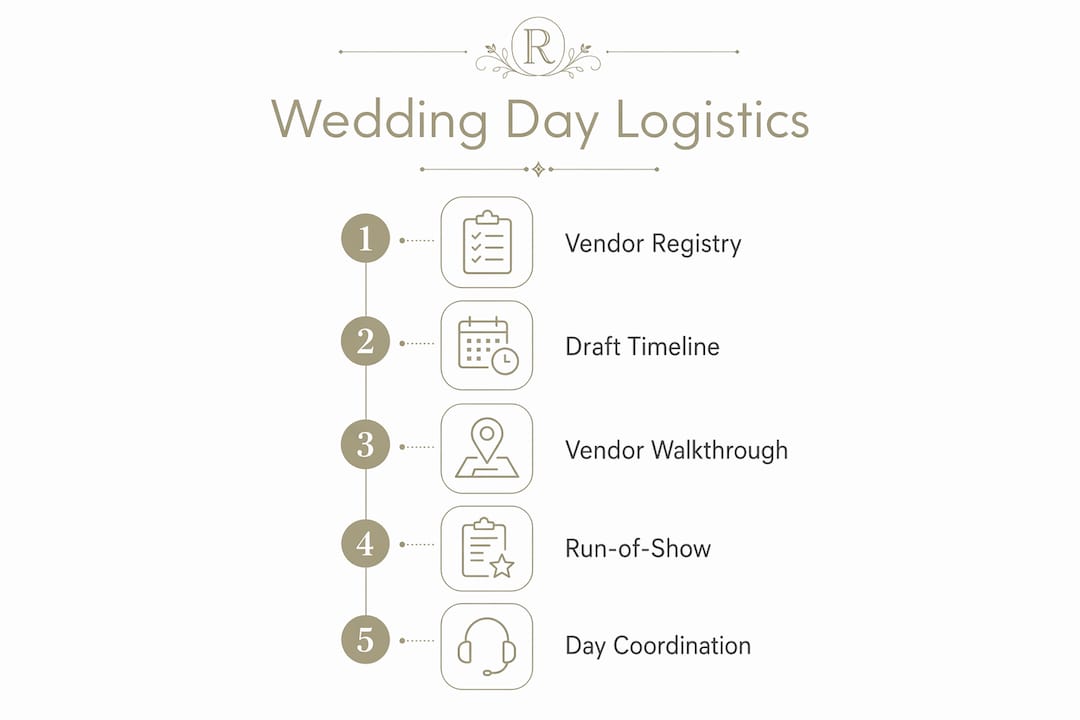
Your first task is to create a master binder or digital planner that holds every contract, vendor contact, timeline draft, and contingency note in one place. Centralising vendor operational data into a single accessible document reduces miscommunication significantly. When vendors operate from fragmented emails or outdated printed sheets, errors multiply and delays cascade. A well-structured digital planner, whether built in Google Sheets, Notion, or a dedicated wedding planning platform, becomes the operational backbone of your entire day.
Your master system should include:
- Vendor registry: Full name, company, mobile number, and arrival time for every supplier
- Contracts folder: Digital copies of signed agreements, including payment terms and cancellation clauses
- Emergency kit checklist: Safety pins, stain remover, pain relief, a phone charger, and a printed copy of the timeline
- Transport schedule: Arrival and departure windows for the wedding car, guest shuttles, and vendor vehicles
- Venue floor plan: Annotated with setup zones, photo locations, and catering stations
Pro Tip: Walk through the venue with each vendor on arrival to confirm setup details in real time. Physically verifying positions and access routes prevents assumptions about contract specifics that can cause costly last-minute confusion.
| Preparation task | When to complete |
|---|---|
| Compile vendor registry | 6 weeks before |
| Distribute draft timeline | 3 weeks before |
| Conduct venue walkthrough | Day before or morning of |
| Pack emergency kit | Night before |
| Print final timeline copies | 48 hours before |
How do you create a detailed wedding day timeline?
The run-of-show document is the operational heartbeat of your wedding day, and it is categorically different from a general wedding schedule. A run-of-show details minute-by-minute operational steps accessible digitally by all vendors, including transition details such as usher briefings, music changes, and lighting cues. A general schedule tells guests when dinner is served. The run-of-show tells your caterer, photographer, and DJ exactly what happens in the three minutes before dinner is announced.
Creating your run-of-show step by step
- Anchor to the ceremony start time. Work backwards from this fixed point to determine when hair and makeup must begin, when the wedding car departs, and when vendors need site access.
- Map every transition moment. Note who is responsible for each handoff: who cues the string quartet, who signals the ushers, who confirms the florals are in position.
- Build in strategic buffer time. A 30-minute cushion after hair and makeup and a floating 15-minute gap before the ceremony start absorb the inevitable small delays without disrupting the entire day.
- Upload to a shared digital format. Google Sheets works exceptionally well because every vendor can access the live document from their phone, and any update you make is visible instantly.
- Distribute at least 48 hours ahead. Send the final version to every vendor, your wedding party, and your designated coordinator with enough time for questions to be resolved before the day itself.
Pro Tip: Apply buffer times only at major transitions, not every single activity. Adding padding everywhere makes the day unrealistically long and creates its own form of schedule fatigue.
| Document type | Purpose | Audience |
|---|---|---|
| General wedding schedule | Guest-facing overview of key events | Guests, family |
| Run-of-show | Minute-by-minute operational plan | All vendors, coordinator |
| Emergency contact sheet | Rapid-access numbers for issues | Coordinator, couple |
A well-constructed wedding day timeline also protects your photography. When your photographer knows precisely when the first look is scheduled and how long family portraits are allocated, they can position themselves to capture every significant moment without rushing or missing transitions.
What is the 3-wave vendor confirmation system?
The 3-wave confirmation protocol is the single most effective system for preventing vendor no-shows, miscommunications, and last-minute surprises. It structures your vendor communication into three deliberate checkpoints, each with a specific purpose and a clear expectation of response.
- Wave 1 (30 days before): Send a formal reconfirmation of the agreed scope of services. Ask each vendor to confirm their arrival time, equipment requirements, and any outstanding logistical needs. This wave catches contract misunderstandings while there is still time to resolve them.
- Wave 2 (7 days before): Focus on operational details. Share the finalised run-of-show, confirm parking and access arrangements, and clarify any venue-specific requirements such as noise restrictions or load-in windows.
- Wave 3 (48 hours before): A brief, warm check-in confirming readiness. If a vendor fails to respond within 24 hours during this final wave, immediate phone contact is mandatory. Silence at this stage is a red flag, not an oversight.
Pro Tip: Keep a backup contact for every critical vendor category: a second florist, an alternative DJ playlist, a trusted friend who can drive if the wedding car company fails to appear. Backup planning is not pessimism. It is professionalism.
"Coordination is roughly 30% planning and 70% communication." This principle, drawn from professional wedding planning practice, means that your vendor confirmation system is not administrative housekeeping. It is the primary mechanism through which your wedding day either holds together or falls apart.
Centralising all vendor communication in one place, whether a shared folder in Google Drive or a dedicated wedding planning platform, means that if you hand over coordination duties to a trusted contact on the day, they have everything they need without asking you a single question.
How do you manage key transitions and contingencies on the day?
On the wedding day itself, the coordinator's role shifts from planning to anticipation. Staying 15 minutes ahead of scheduled events and working the timeline rather than the room is the defining discipline of professional wedding day management. This means verifying with the caterer that the starter course is plated before guests are seated, not after.

Setting up your command station
Designate a physical command station, typically a quiet corner of the venue, equipped with a printed timeline, the full vendor contact list, your emergency kit, and a charged phone. This becomes the operational centre from which all decisions flow. Your lead coordinator works from here, not from the dance floor.
- Assign a single point of contact for the couple. A designated go-to contact briefed on the timeline allows you and your partner to be fully present without fielding logistical questions. This person can be a trusted friend or family member with authority to make small decisions.
- Conduct arrival walk-throughs with each vendor. Physically confirming setup positions on arrival prevents assumptions about contract specifics from becoming expensive surprises.
- Monitor transitions in real time. Check in with each vendor team 10 minutes before their scheduled moment, not at the moment itself.
- Apply the 60-second escalation rule. If a problem cannot be resolved within 60 seconds, it must be escalated to the lead coordinator immediately. Attempting to solve a complex issue alone wastes precious time and creates downstream delays.
- Adapt the timeline tactfully. If the ceremony runs 20 minutes long, shorten the cocktail hour rather than compressing the reception. Protect the moments that matter most to the couple.
Pro Tip: Brief your bridesmaids and groomsmen on their specific roles in the timeline. Knowing how to brief your wedding party effectively means you have a distributed team of calm, informed supporters rather than a group waiting to be told what to do.
| Transition moment | Buffer recommended | Responsible contact |
|---|---|---|
| End of hair and makeup | 30 minutes | Lead coordinator |
| Pre-ceremony gathering | 15 minutes | Usher lead |
| Ceremony to drinks reception | 20 minutes | Venue manager |
| Dinner seating | 10 minutes | Caterer and coordinator |
What common mistakes undermine wedding day logistics?
The most damaging errors in wedding logistics are rarely dramatic. They are quiet failures of preparation that compound throughout the day until the timeline is unrecoverable.
- Insufficient buffer time around major events. Couples who schedule hair and makeup to finish exactly at departure time have no margin for the inevitable. One delayed stylist collapses the entire morning.
- No shared operational timeline. When vendors work from individual briefing emails rather than a single live document, version conflicts and missed updates are guaranteed.
- Skipping the vendor confirmation protocol. Assuming a vendor is prepared because they were confirmed six months ago is one of the most common and costly mistakes in wedding planning.
- Overloading the timeline. Scheduling too many activities in short windows, particularly around the ceremony and first dance, creates a frantic atmosphere that no amount of coordination can fully rescue.
- No clear escalation process. The most common failure point in wedding logistics is the absence of a structured escalation process for on-the-day issues. Without one, small problems grow unchecked.
- Underestimating contingency planning. Weather, vendor no-shows, and equipment failure are not rare occurrences. They are predictable categories of risk that deserve a written response plan.
"When vendors operate from fragmented emails or outdated printed sheets, errors and delays occur." The solution is not more emails. It is one authoritative, shared, live document that every stakeholder trusts as the single source of truth.
Key takeaways
Successful wedding day logistics rest on three pillars: a single live operational timeline, a structured vendor confirmation system, and a designated coordinator empowered to make real-time decisions.
| Point | Details |
|---|---|
| Start coordination early | Begin formal logistics planning at least four to six weeks before the wedding day. |
| Build a live run-of-show | Use Google Sheets or a shared digital format so all vendors access the same real-time document. |
| Use the 3-wave protocol | Confirm vendors at 30 days, 7 days, and 48 hours out to prevent no-shows and miscommunication. |
| Buffer major transitions only | Add padding at key moments such as post-makeup and pre-ceremony, not throughout every activity. |
| Designate a lead coordinator | Assign one trusted person to manage logistics so the couple can be fully present on the day. |
What I have learned from years of working alongside wedding coordinators
After photographing hundreds of weddings, including intricate, multi-day Asian ceremonies with dozens of vendors and moving parts, I have come to believe that the couples who enjoy their wedding day most are those who have completely offloaded logistics to a trusted system and a trusted person. They are not checking their phones. They are not whispering to the caterer. They are present, radiant, and genuinely in the moment.
The insight that changed how I think about wedding day coordination is this: communication is not a support function. It is the primary function. Coordination is 70% communication, and the planners who understand this invest their energy in relationships and clarity, not just spreadsheets. A beautifully constructed timeline means nothing if the florist has a different version saved on their laptop from three weeks ago.
Technology has genuinely transformed this space. Shared digital timelines, accessible from any phone, mean that a real-time update from the coordinator reaches every vendor simultaneously. I have watched this prevent genuine crises on the day, from a caterer who arrived at the wrong entrance to a photographer who needed an extra 20 minutes for family portraits. The proactive mindset that anticipates rather than reacts is what separates a memorable wedding from a stressful one.
My honest advice: do not try to coordinate your own wedding day. Delegate with authority, brief your team with specificity, and then let go. The most cinematic, emotionally resonant images I capture are always of couples who are fully present, not managing logistics from the corner of the room.
— Rashpal
How Rashpal Photography integrates with your wedding day plan
A professional photographer is not simply a supplier who arrives and shoots. At Rashpal-photography, we work directly within your run-of-show, aligning our wedding photography coverage with every transition, from the bridal preparations through to the final dance. We receive your timeline in advance, contribute to the photography schedule during the planning process, and coordinate with your venue and other vendors to ensure every significant moment is captured without disrupting the flow of your day.

For couples planning a full-day celebration, our 12-hour essentials package is designed to match the rhythm of a detailed logistics plan, providing continuous coverage from morning preparations to the evening reception. If you are in the early stages of planning and want to understand how photography fits into your broader coordination, our wedding planning guide is a considered starting point. We also recommend reviewing photography planning insights to understand how a planning meeting with your photographer can strengthen your overall timeline.
FAQ
What is a run-of-show document?
A run-of-show is a minute-by-minute operational plan shared with all vendors, detailing every transition, cue, and responsibility throughout the wedding day. It differs from a general guest schedule in its level of operational specificity.
How far in advance should vendor confirmation begin?
The 3-wave confirmation protocol begins 30 days before the wedding with a formal scope reconfirmation, followed by operational details at 7 days, and a final readiness check at 48 hours out.
How much buffer time should a wedding timeline include?
Strategic buffer times of 30 minutes after hair and makeup and 15 minutes before the ceremony start are the most effective placements. Applying buffers only at major transitions prevents the day from running unnecessarily long.
Who should be the designated coordinator on the day?
A trusted friend, family member, or professional coordinator briefed fully on the timeline can serve as the lead contact. This person fields all logistical questions so the couple remains free to enjoy the celebration.
What is the most common logistics failure on a wedding day?
The absence of a clear escalation process is the most frequent failure point. Any issue that cannot be resolved within 60 seconds should be escalated to the lead coordinator immediately to prevent it from disrupting the wider timeline.
Recommended
- Newly engaged? Here’s how to start your Asian wedding planning! Rashpal Photography | Wedding Photographer Uxbridge, UK
- How to Save Money on Your Wedding Rashpal Photography | Wedding Photographer Uxbridge, UK
- How to Choose the Perfect Wedding Location Rashpal Photography | Wedding Photographer Uxbridge, UK
- 6 Ways To Arrive At Your Asian Wedding In Style! Rashpal Photography | Wedding Photographer Uxbridge, UK